creating stories that matter
Life I Want: Bill Chambers
The child of a lobster fisherman in a tiny South Australian coastal town, country singer-songwriter Bill Chambers always followed his heart—from raising his young family as a fox hunter in the Outback to touring around the world as part of his famous daughter Kasey’s band.
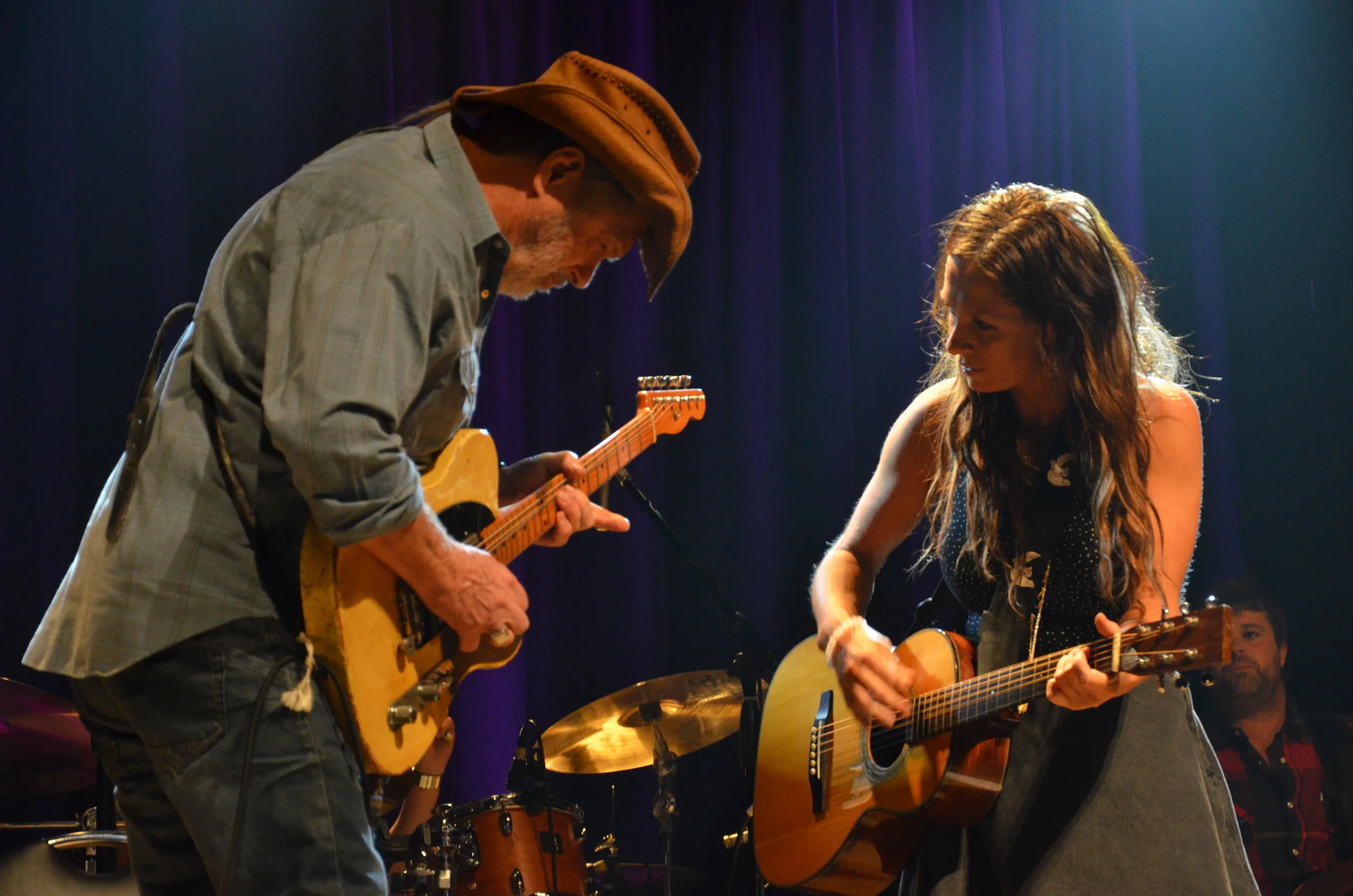
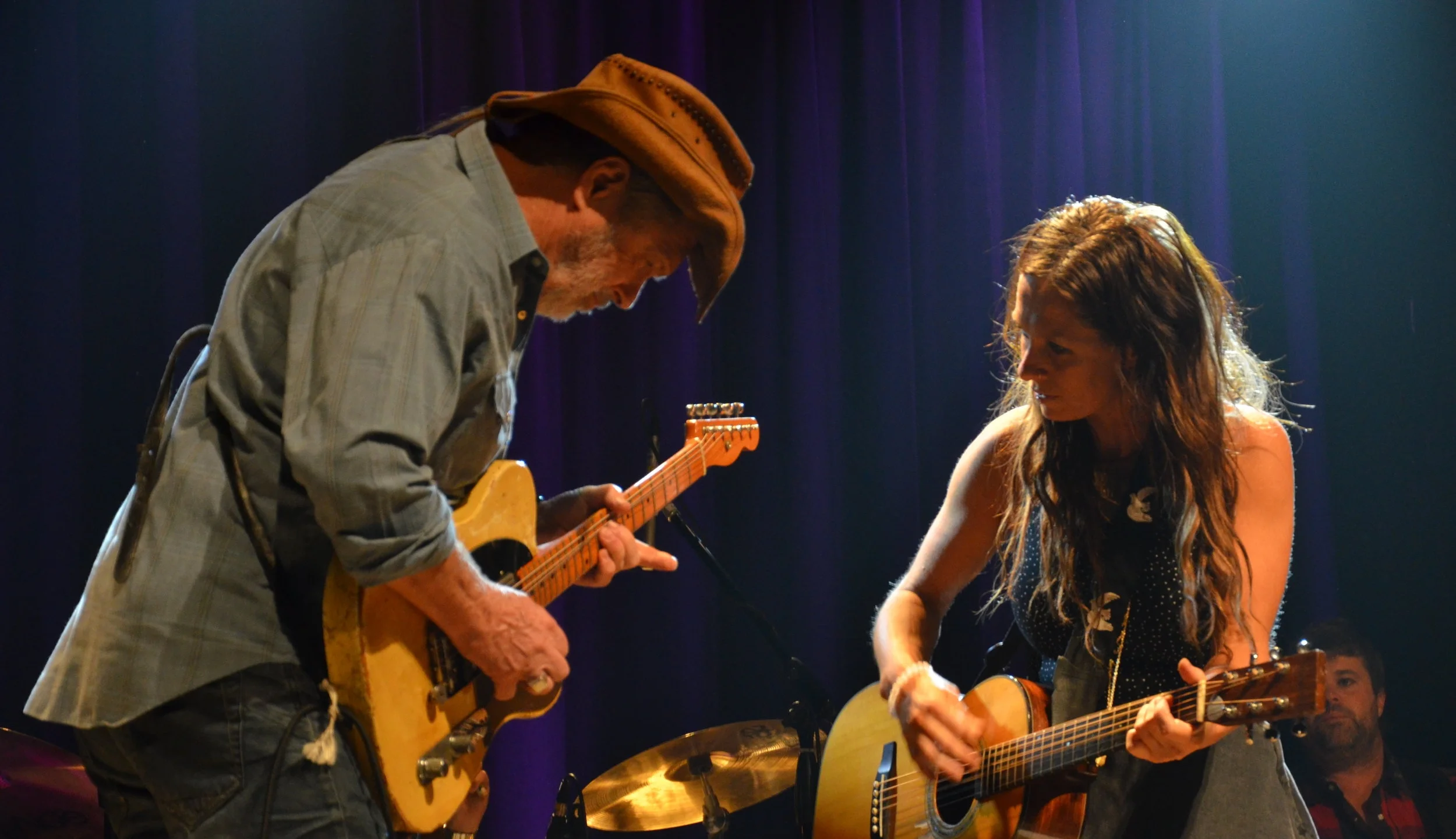
Australian country singer-songwriter Bill Chambers playing with his daughter, Kasey. Photo courtesy of Bill Chambers.
Name: Bill Chambers
Occupation: Country singer-songwriter
What’s your superpower? “I think the communication with music is a superpower—anything that tells stories from the heart.”
About this series: In this blog series, I profile people who have made a conscious decision to craft a life that allows them to meet their personal and professional aspirations. The series is intended to celebrate those who are living the life they want and to inspire others to do the same. Also, I ask everyone about their superpower, a question inspired by Ruth Ozeki’s great, great book A Tale for the Time Being.
Anyone who has ever fallen in or out of love, left home and moved as a stranger to a new place, or experienced the bewildering change that comes with new life or loss—that is, anyone who is human—can likely identify a song that captures their feelings in that moment. Music can inspire and console, champion and challenge, give us courage or give us solace.
There is a musician who can speak to every different type of heart.
Perhaps that is because becoming a musician takes a certain strength of heart—the ability to listen to what the heart really wants and go for it, money or fame be damned.
A few years ago, I was fortunate to meet Australian singer-songwriter Bill Chambers at the concert of his famous daughter, Kasey, whose stage he has been sharing as a band mate for more than a quarter of a century. At the time, he and Kasey were in the midst of a U.S. tour. Chambers talked with me about how his family went from singing together around the campfire when they lived in the Australian Outback to playing together in the country music mecca Nashville.
You grew up in a very small town in South Australia and made the decision as a dad to take your young family to live in the Nullarbor Plain. Tell me about those early years.
I grew up in a fishing village in South Australia, and my dad was a lobster fisherman. We were the only kids in the town of smelly old fishermen. In the meantime, I was listening to a lot of country music, and in my teens, I discovered Bob Dylan and the Beatles.
For a while, I was an ambitious young guitar player and used to appear on TV in Adelaide on a national show called Country Music Hour. But once I had children, my priorities changed. My wife and I decided to head to the Outback, for a totally different lifestyle. My mum and dad always lived off the land, catching local fish and growing their own vegetables, and I grew up naturally believing that if you want something done, you do it yourself, and if you want to eat something, you either hunt it or grow it.
So we picked up and moved to the Nullarbor Plain, the most remote desert, just above the Great Australian Bight. It was in the middle of the fox trade in the early ‘70s, and you could actually hunt Australian foxes, dry the skins, and sell them to Europe for quite a bit of money. My son, Nash, was 3 years old, and my daughter, Kasey, was three weeks old. My wife didn’t feel comfortable and freaked right now, but I said, “Look, we’re just here for a working holiday for four or five weeks.” I was trying to convince her this was a good idea. We didn’t stay for four weeks; we stayed for 10 years.
Eventually, my wife grew comfortable with it, and the kids grew up listening to my music around the campfire, and my wife home-schooled them. We’d sit around the campfire and sing songs, and my daughter was very influenced by the songs. So as my kids got into music, we formed a family band.
How did that experience influence your life today?
My life today is far different from where I come from or where I grew up, but it’s similar in the sense that it’s the survival of the fittest. We may be on tour in New York—about as far from the desert as you can get—but every day you deal with different problems, and you have to think quick and make decisions.
What are some of the values you have prioritized in creating your life as a musician—what are the ingredients that have made this life work for you?
I have always been ambitious and you can be ambitious in different ways—ambition is a great thing if you don’t use it against other people. I’m still ambitious. Every day, I come up with new ideas. My main thing is to create music that we’re proud of, don’t sell out, and treat people well. I like to be asked back at the venues we play at. People are good to us, and I want them to know we appreciate it. I have instilled in my daughter those values, and I think she takes it very seriously. You get out of life what you put into it. It’s not all take; you’ve got to give as well.
What has been your biggest challenge?
Finances are a problem for musicians these days. It’s very hard to make any extra money. We just survive week to week—that’s the price you pay for being on the road and living the life of a musician. But I don’t even think about it anymore. I almost always have a bed to sleep in. Even Kasey, who has done very well in the music business, hasn’t pursued the life of a superstar. She’s not tied to any particular lifestyle. She goes grocery shopping, she helps carry the instruments like the rest of us when we gig, she’s got three kids, and she wants to be a normal mother. Those things are more important than making a million dollars and being a celebrity.
What have you learned by choosing to craft your life this way?
I believe you’ve got to follow your heart. Most people these days just conform to a lifestyle, and have a normal job, working for someone. Even if people hate their job, they think, “This is what I have to do.” I don’t think you have to do that. I think you need to look for what your heart wants to do: Follow your heart and your gut feeling, believe in yourself, and don’t give up. I’m not going to give up till the day I die. I’ve made so many mistakes, but I’ve made more right ones than wrong ones.
Last question: What’s your superpower?
I think the communication with music is a superpower—anything that tells stories from the heart. So many people have come up to me and said, “You changed my life.” I have no doubt that’s a superpower.

Life I Want: Rick Ridgeway
Rick Ridgeway turned his passion for mountain landscapes and environmental conservation into a life as a mountaineer, writer, photographer, filmmaker, and, today, vice president of public engagement at the outdoor company Patagonia.

Photo of Rick Ridgeway on Antarctic expedition courtesy of Gordon Wiltsie: www.alpenimage.com.
Name: Rick Ridgeway
Occupation: Mountaineer, author, photographer, filmmaker, and vice president of public engagement at Patagonia
What’s your superpower? “It’s very connected to having a passion. If you have a passion, how do you activate that? How do you use it as a framework to make your decisions? If you don’t do that, you are probably not going to realize your passion. Looking back on it, I think the attribute I used most effectively was tenacity. I developed a tenacious commitment to do what it took to realize my passion. And it worked for me.”
About this series: This blog series profiles people who have made a conscious decision to craft a life that allows them to meet their personal and professional aspirations. The series is intended to celebrate those who are living the life they want and inspire others to do the same. Also, I ask everyone about their superpower, a question inspired by Ruth Ozeki’s great, great book A Tale for the Time Being.
When I interviewed Rick Ridgeway last October, he had just returned home from a short trip to Boulder, Colorado. He told me that as the plane flew over San Gorgonio, Southern California’s highest peak, he was thinking about when he first went to that mountain in high school. It was 1966, Ridgeway was 16, and he was inspired to learn to climb after seeing a National Geographic cover photo of Jim Whittaker holding the American flag at the top of Mt. Everest—the first American to climb the world’s highest mountain.
“I thought, I want to be that guy,” Ridgeway told me. “So I went out and bought an ice ax, some Italian boots, and the book Freedom of the Hills. And I went up San Gorgonio and taught myself how to use the ice ax and crampons.”
That was the moment Ridgeway made a personal commitment to pursue his passion. “I said, I’m never going to give up on this,” Ridgeway said. “And 12 years later, I was on the first ascent of K2, and the leader of the group was Jim Whittaker.” This time, Ridgeway was standing alongside Whittaker on the cover of National Geographic.
Twenty years later, on an expedition to Antarctica with Alex Lowe and Conrad Anker, the team was holed up in their tent waiting out a storm when Anker told Ridgeway that his cover photo had inspired Anker’s own passion for mountaineering. “Conrad said, ‘You know, Rick, I haven’t told you this, but when I was younger, I had been thinking about climbing, and I got my National Geographic with you on the cover, and I thought, that’s it, I’m going to be that guy,’” Ridgeway said. “We got back from that trip, and I got my National Geographic, and there’s Conrad Anker on the cover, and I told Conrad, somewhere, there’s a young guy who’s saying, ‘I want to do that. I want to be that guy.’”
On the flight, Ridgeway said he was trying to imagine what it would be like if his 16-year-old self could have known that 50 years in the future, this grey-haired man would look over that same mountain and recognize that his life’s path started there. “It all began with this commitment to a passion—a real commitment, an unwavering commitment,” Ridgeway said.
From Hobby to Professional Path
Ridgeway pointed out that he has held a “regular job” for only the past 12 years as a full-time employee at the outdoor company Patagonia. “The main reason I never worked for a company is that I never imagined myself being able to fit into a corporate environment,” he said. To be sure, Patagonia is a unique company with an anti-corporate culture whose spirit is captured in founder Yvon Chouinard’s philosophy, “Let my people go surfing.”
Before settling into his role as vice president of public engagement at Patagonia, Ridgeway made a life as a mountaineer, photographer, author, and filmmaker. His interest originated when, as a teenager, he went to the mountains to escape what he describes as “the destruction around me,” as developers transformed the rural agricultural landscape of Orange County into row after row of tract houses.
As he got older, he decided to turn his hobby into a professional pathway. “I realized that I needed to find a way to pursue my occupational life in a way that embraced by vocational life,” he said. He started by pursuing photography and writing. When Ridgeway was in his 30s, he opened his own business representing photographers and filmmakers who sold their work for commercial purposes. At the height of this business, Ridgeway had 20 employees and represented 160 people.
First ‘Regular’ Job
He sold his company in 2000 and then went on to pursue his own filmmaking, writing, and photography. In 2003, he joined the Patagonia board, and in 2004 he was offered a full-time job.
“They invited me to become an employee, and I had never thought about that,” Ridgeway said. “They needed somebody to oversee environmental initiatives and to communicate their environmental commitments without being misunderstood and charged with greenwashing, and that sounded like a cool challenge.”
As an old friend and climbing partner of Chouinard’s, Ridgeway also understood that Patagonia had a different ethos and respected the need for employees to have work-life balance. In addition to its famed powder and surf clause, Patagonia has offered on-site childcare since 1982, when Chouinard’s wife, Malinda, and Ridgeway’s wife, Jennifer, who cofounded Patagonia’s marketing department, set up a trailer staffed with a babysitter at the headquarters. (The daycare center is now an impressive child-development center that teaches kids to take safe risks and become confident in their own abilities.)
Ridgeway says this approach has helped build the company’s core culture and helped Patagonia retain employees. “Life has a better chance of being meaningful if we find a balance between our work and personal life that feels right for us,” he said. “Then people will enjoy coming into work and they will be passionate about their life in work and outside of work.”
Given the philosophy of Patagonia’s founder, it is not surprising that the company culture is what it is. What is surprising is that more companies don’t realize that to attract people like Ridgeway, the culture of the organization is paramount—though Ridgeway says that is changing. “The common challenge for other companies is self-limitation: thinking that principles like this will cost money—that it will cost the company to give their employees a better work-life balance,” he said. “We have discovered that that’s not true. We have such a committed workforce that the loyalty from employees provides significant value to the company. It’s as simple and basic as the fact that when employees are happy, they get more work done. Teamwork gets stronger, and the overall commitment from employees is as strong as it could conceivably be.”
A Commitment to the Last Step
Ridgeway is generous in sharing his story, which has not been without hardship. Like anyone trying to carve out their own path, he has experienced financial challenges. And like many professional mountaineers, he has experienced tragedy. “There’s always going to be road bumps, and some of them get pretty big,” he said. “The biggest one in my life was getting in an avalanche in 1980 when my best friend died in my arms, and then finding the inner strength to recommit—that was really hard to do.” (A few months after I spoke with Ridgeway, he experienced a similar tragedy when North Face Founder Doug Tompkins drowned in a kayaking accident that Ridgeway survived. Ridgeway wrote about the experience in a Patagonia blog entitled “To Those Who Loved Doug.”)
It would be remiss to tell Ridgeway’s story without mentioning that he is married and has three children. “I had an unusual career path because I retired first, which was cool. I figured it out,” he said. “But the real hero in this story is my wife. She’s the one who raised our three kids while I was out being a professional climber, and that’s how I created income for our team. But, boy, she gets the credit for holding down the fort.”
The two have been married for more than 30 years, and Ridgeway said they went into this life together with a mutual understanding: “We committed to each other without all the answers.”
This lack of knowing what’s next is one of the reasons Ridgeway titled his book about the ascent of K2 The Last Step, which references a passage in Rene Daumal’s Mount Analogue. “There’s a quote in there: ‘The last step depends on the first,’” Ridgeway said. “You have to commit. You don’t have all the answers, and you won’t get to the last step until you commit to the first step. It’s knowing that the first step depends on the last, and the last step depends on the first. It works both ways, and it requires you to envision the whole thing.”

Creating the Life I Want—and a New Blog Series
More than a third of all Americans today gain income from freelance work. And with telecommuting and flexible work schedules, even traditional employment is changing. How can you craft your work to create a fulfilling life? My new blog series—profiling people who are creating the life they want—provides a playbook on how to do this.

Our new house in Australia, in the vineyard, among the roos and cockatoos.
Shortly after my 25th birthday, I was sitting in the People’s Café on San Francisco’s Haight Street, drawing a rudimentary pie chart to show my friend Monica the things I needed in my life for balance. My chart had three wedges:
People, for proximity to my friends and family.
Place, for my physical home and how close that home was to the backcountry.
Profession, for job fulfillment and income.
It was the year 2001, the environmental news site I had been editing for had folded, and I was about six months into a job as an editor at the investigative reporting magazine Mother Jones. I was earning less than $28,000 per year, a low figure even in those times.
Monica and I were planning our futures, and my pie chart was intended to put in perspective why I could afford to take such a low-paying gig.
Profession: I believed the kind of journalism we were doing at Mother Jones was meaningful work.
People: I had plenty of friends, and my family was just a five-hour drive up I-5.
Place: My daily trail run in the Berkeley Hills, where I lived at the time, was just two miles away.
Still, I was thinking about how I could change my situation to spend more time outside. Maybe I could do a job share at Mother Jones and start up a dog-walking/freelance-writing business on the side?
For reasons I can’t quite understand now, I decided I wouldn’t be able to match my meager salary working for myself, and I filed away my plan to go freelance.
Fast-forward 15 years. With me nearing 40, my twins nearing 5, and my husband, Adam, nearing 50, my family and I have decided to radically change our lives. For the past 10 years, Adam has been developing a vineyard and making his own wine from a rural property two hours west of Melbourne in his native Australia, and we planned to move our family there. He would leave his corporate winemaking job to become a winemaker/farmer/dad, and I would leave my communications job at an international nonprofit organization to become a writer/editor/mom.
People: Great friends in our new town of Great Western, which is just a five-hour flight from Adam’s family in Perth.
Place: Half hour from some of Australia’s best rock climbing in the Grampians National Park. Home off a red dirt track surrounded by vines, roos, and cockatoos.
Profession: We both get to work for ourselves, even if we do have to live the life of a poor farmer and a hungry writer.
The ‘Eva Model’
While we had always planned to move to Australia, the decision for me to go freelance while still living in the United States happened gradually. About a year ago, I was going through the onerous task of writing my annual goals. I loved my job, but I dreaded the chore of conjuring up a target number of media hits we should earn, or the ideal number of climate-focused blogs we should publish. I started to wonder: What if I set goals that were meaningful to me? Like, run as many miles as I work hours per week, giving new meaning to the term “miles per hour.” Or walk my kids to their new school every day.
Once I started, I couldn’t stop: Play a Scott Joplin piece, straight through, on the piano. Spend more nights sleeping in a tent. Teach the kids to ski on my home hill, Mt. Ashland. Better yet, let my dad teach them to ski, while Adam and I take some telemark turns down the Ariel chairline. Write my own blog (check).
That weekend, Adam and I got the kids a sitter and hashed out our plans over dinner: We couldn’t afford for me to leave my job until the kids started public school, which they would do in September of 2015. Then I could ramp up my freelance business and still have more time to spend with the kids. We would move to Australia in September of 2016.
Two months before I left my job, I worked closely with my boss and my team to ensure a smooth transition. We discussed responsibilities I could continue as a freelancer, which gave the team more time to think about how and whether to fill my position, and gave me a solid pipeline of work to start my business.
After I left my job, a couple of my other colleagues took a similar route, leaving their full-time positions and consulting back to the organization to do some of the work they had previous led. One friend told me people have started to refer to this as “the Eva Model.”
The New Gig Economy
I might have launched a trend at my old workplace, but the Eva Model is pretty common these days. According to an article Freelancers Union Founder Sara Horowitz published in the Bureau of Labor Statistics’ Monthly Labor Review, more than 53 million Americans—one in three workers—are now earning income from work that’s not a traditional 9-to-5 job. It’s not just the advent of the gig economy that has made it easier to follow the Eva Model. With social networks, it’s easy to find organizations that need skills and experience you can offer, even if you’re an ocean away from their headquarters.
When I started developing my freelance business, I discovered a whole world of these people, several of whom have jobs that primarily service the freelance community. I hired a freelance designer to help me set up my website and a Mac expert who sorted out my IT systems. I sought advice from a friend who helps people become influencers on social media, and another friend who writes/edits/dads (a profession my writer/editor/yoga-teacher friend refers to as being a “slasher”).
For a story assignment, I interviewed another woman who blogs/writes/hosts-videos on money and is now writing an ebook on personal finance. At my kids’ new preschool, I met a pregnant mom of two whose Swiss Cheese Childcare business helps busy parents find pre-approved sitters on short notice. I met another mom who shares a job teaching the second grade in a local public school and spends the rest of her time raising her twin boys and volunteering at the school.
Meeting this community got me thinking about the common theme among all of these individuals: They are each crafting the life they want. And even though it’s now easier than ever to dip into the gig economy and create the life you want, there’s no playbook on how to do it.
I decided to write one.
Creating the Life You Want: My New Blog Series
Two years before I was born, the oral historian Studs Terkel published the book Working, a series of interviews with people talking about what they do all day, and how they feel about it. He spoke with more than 100 people—a waitress, a cab driver, a farm worker, a sports executive, a press agent, and many more—and the resulting work has become a favorite of many people, mainly because Terkel profiled real people, using their own words.
I bring him up here to, in modern-day parlance, give Terkel a hat tip, for I wish to follow in his footsteps with my blog new series, profiling real people, and their efforts to create the lives they want. Forty years after Terkel’s book was published, people still spend the bulk of their time at work, so my focus in this blog series is how people are creating the lives they want through their work.
Given the changing nature of the workforce, this is a relevant time to explore the subject. In addition to the increasing number of people who are earning incomes from nontraditional work, the workforce itself is transforming. According to a Gallup survey published in August, 37 percent of Americans now telecommute for work, up from 9 percent in 1995. Interestingly, a 2013 Gallup article reported that although most remote workers log more hours, they are more engaged at work.
Employee engagement is an important dimension in the workplace because it influences productivity, which affects an organization’s performance. But Gallup reports that only 13 percent of workers worldwide are engaged in their jobs. In the United States, the figures are slightly better: 30 percent of workers are engaged, but a surprising 18 percent—nearly one in five people—are actively disengaged, which Gallup defines as emotionally disconnected from work, unproductive, and potentially hostile.
The good news is that more companies are beginning to recognize that employee satisfaction is important, and those places are focused on developing workers’ strengths and enhancing their well-being—two of the three main factors Gallup says are most influential in employee engagement. And, of course, employees who are unhappy in traditional roles now have more opportunities to create their own niche working for themselves.
I believe the nature of the workforce is changing, and that 10 years from now, more people will be self-employed, while others will work for traditional employers who are offering flexible work opportunities that allow people to be both more engaged in their work and more engaged in their homes and communities. I envision a future where people are leading the lives they want, creatively building their professional career around what they really want to achieve in life, in work, or in the world.
But because this is a wide-open field, and there’s no single playbook, some people may struggle with how to craft this life. My new blog series is for them—to celebrate those who are living the life they want, and to inspire others to do the same.
Already, I have interviewed a number of interesting people: the father of Australia’s most famous country singer, who took his young family out for a three-week camping trip in the Outback—and ended up staying there for 10 years; a Harvard Business School-trained venture capitalist who spent the past 10 years fundraising and connecting with people around the globe to build a hospital in rural India; and a former Medill classmate of mine who has been freelancing for his entire professional career—the trigger for his decision was when a source pulled a gun on him.
In this blog series, I will profile people from all walks of life to chronicle how they have created the life they want, what has gone well, and what hasn’t.
When Things Don’t Go to Plan
Two weeks after I started my freelance business, on September 11, Adam was “restructured” out of his job a year earlier than expected. In our scenario-planning, we had been thinking about a plan B for our Australia life: What if we don’t sell enough wine, what if the Aussies don’t want to hire an American editor, what if climate change, drought, late payments on wine sales, late checks on writing assignments. We didn’t plan the “what if” for our last year in America.
But here’s the thing: Even when you are leading the life you want—even when you are spending more time running or practicing Scott Joplin or reading the kids E.B. White—things don’t always go to plan.
Since the news about Adam’s job last month, we have adjusted our plans. We will leave for Australia a few months early. I will take on more freelance work. He will be the one walking the kids to and from school. I will have a house-husband. He will have a breadwinner. The kids will have two parents who are more fulfilled in life and around a lot more often. With luck, we’ll all have the life we want.
Now I have to run—literally. I have at least 35 miles to log this week if I want to meet my goals.