creating stories that matter

Life I Want: Rick Ridgeway
Rick Ridgeway turned his passion for mountain landscapes and environmental conservation into a life as a mountaineer, writer, photographer, filmmaker, and, today, vice president of public engagement at the outdoor company Patagonia.

Photo of Rick Ridgeway on Antarctic expedition courtesy of Gordon Wiltsie: www.alpenimage.com.
Name: Rick Ridgeway
Occupation: Mountaineer, author, photographer, filmmaker, and vice president of public engagement at Patagonia
What’s your superpower? “It’s very connected to having a passion. If you have a passion, how do you activate that? How do you use it as a framework to make your decisions? If you don’t do that, you are probably not going to realize your passion. Looking back on it, I think the attribute I used most effectively was tenacity. I developed a tenacious commitment to do what it took to realize my passion. And it worked for me.”
About this series: This blog series profiles people who have made a conscious decision to craft a life that allows them to meet their personal and professional aspirations. The series is intended to celebrate those who are living the life they want and inspire others to do the same. Also, I ask everyone about their superpower, a question inspired by Ruth Ozeki’s great, great book A Tale for the Time Being.
When I interviewed Rick Ridgeway last October, he had just returned home from a short trip to Boulder, Colorado. He told me that as the plane flew over San Gorgonio, Southern California’s highest peak, he was thinking about when he first went to that mountain in high school. It was 1966, Ridgeway was 16, and he was inspired to learn to climb after seeing a National Geographic cover photo of Jim Whittaker holding the American flag at the top of Mt. Everest—the first American to climb the world’s highest mountain.
“I thought, I want to be that guy,” Ridgeway told me. “So I went out and bought an ice ax, some Italian boots, and the book Freedom of the Hills. And I went up San Gorgonio and taught myself how to use the ice ax and crampons.”
That was the moment Ridgeway made a personal commitment to pursue his passion. “I said, I’m never going to give up on this,” Ridgeway said. “And 12 years later, I was on the first ascent of K2, and the leader of the group was Jim Whittaker.” This time, Ridgeway was standing alongside Whittaker on the cover of National Geographic.
Twenty years later, on an expedition to Antarctica with Alex Lowe and Conrad Anker, the team was holed up in their tent waiting out a storm when Anker told Ridgeway that his cover photo had inspired Anker’s own passion for mountaineering. “Conrad said, ‘You know, Rick, I haven’t told you this, but when I was younger, I had been thinking about climbing, and I got my National Geographic with you on the cover, and I thought, that’s it, I’m going to be that guy,’” Ridgeway said. “We got back from that trip, and I got my National Geographic, and there’s Conrad Anker on the cover, and I told Conrad, somewhere, there’s a young guy who’s saying, ‘I want to do that. I want to be that guy.’”
On the flight, Ridgeway said he was trying to imagine what it would be like if his 16-year-old self could have known that 50 years in the future, this grey-haired man would look over that same mountain and recognize that his life’s path started there. “It all began with this commitment to a passion—a real commitment, an unwavering commitment,” Ridgeway said.
From Hobby to Professional Path
Ridgeway pointed out that he has held a “regular job” for only the past 12 years as a full-time employee at the outdoor company Patagonia. “The main reason I never worked for a company is that I never imagined myself being able to fit into a corporate environment,” he said. To be sure, Patagonia is a unique company with an anti-corporate culture whose spirit is captured in founder Yvon Chouinard’s philosophy, “Let my people go surfing.”
Before settling into his role as vice president of public engagement at Patagonia, Ridgeway made a life as a mountaineer, photographer, author, and filmmaker. His interest originated when, as a teenager, he went to the mountains to escape what he describes as “the destruction around me,” as developers transformed the rural agricultural landscape of Orange County into row after row of tract houses.
As he got older, he decided to turn his hobby into a professional pathway. “I realized that I needed to find a way to pursue my occupational life in a way that embraced by vocational life,” he said. He started by pursuing photography and writing. When Ridgeway was in his 30s, he opened his own business representing photographers and filmmakers who sold their work for commercial purposes. At the height of this business, Ridgeway had 20 employees and represented 160 people.
First ‘Regular’ Job
He sold his company in 2000 and then went on to pursue his own filmmaking, writing, and photography. In 2003, he joined the Patagonia board, and in 2004 he was offered a full-time job.
“They invited me to become an employee, and I had never thought about that,” Ridgeway said. “They needed somebody to oversee environmental initiatives and to communicate their environmental commitments without being misunderstood and charged with greenwashing, and that sounded like a cool challenge.”
As an old friend and climbing partner of Chouinard’s, Ridgeway also understood that Patagonia had a different ethos and respected the need for employees to have work-life balance. In addition to its famed powder and surf clause, Patagonia has offered on-site childcare since 1982, when Chouinard’s wife, Malinda, and Ridgeway’s wife, Jennifer, who cofounded Patagonia’s marketing department, set up a trailer staffed with a babysitter at the headquarters. (The daycare center is now an impressive child-development center that teaches kids to take safe risks and become confident in their own abilities.)
Ridgeway says this approach has helped build the company’s core culture and helped Patagonia retain employees. “Life has a better chance of being meaningful if we find a balance between our work and personal life that feels right for us,” he said. “Then people will enjoy coming into work and they will be passionate about their life in work and outside of work.”
Given the philosophy of Patagonia’s founder, it is not surprising that the company culture is what it is. What is surprising is that more companies don’t realize that to attract people like Ridgeway, the culture of the organization is paramount—though Ridgeway says that is changing. “The common challenge for other companies is self-limitation: thinking that principles like this will cost money—that it will cost the company to give their employees a better work-life balance,” he said. “We have discovered that that’s not true. We have such a committed workforce that the loyalty from employees provides significant value to the company. It’s as simple and basic as the fact that when employees are happy, they get more work done. Teamwork gets stronger, and the overall commitment from employees is as strong as it could conceivably be.”
A Commitment to the Last Step
Ridgeway is generous in sharing his story, which has not been without hardship. Like anyone trying to carve out their own path, he has experienced financial challenges. And like many professional mountaineers, he has experienced tragedy. “There’s always going to be road bumps, and some of them get pretty big,” he said. “The biggest one in my life was getting in an avalanche in 1980 when my best friend died in my arms, and then finding the inner strength to recommit—that was really hard to do.” (A few months after I spoke with Ridgeway, he experienced a similar tragedy when North Face Founder Doug Tompkins drowned in a kayaking accident that Ridgeway survived. Ridgeway wrote about the experience in a Patagonia blog entitled “To Those Who Loved Doug.”)
It would be remiss to tell Ridgeway’s story without mentioning that he is married and has three children. “I had an unusual career path because I retired first, which was cool. I figured it out,” he said. “But the real hero in this story is my wife. She’s the one who raised our three kids while I was out being a professional climber, and that’s how I created income for our team. But, boy, she gets the credit for holding down the fort.”
The two have been married for more than 30 years, and Ridgeway said they went into this life together with a mutual understanding: “We committed to each other without all the answers.”
This lack of knowing what’s next is one of the reasons Ridgeway titled his book about the ascent of K2 The Last Step, which references a passage in Rene Daumal’s Mount Analogue. “There’s a quote in there: ‘The last step depends on the first,’” Ridgeway said. “You have to commit. You don’t have all the answers, and you won’t get to the last step until you commit to the first step. It’s knowing that the first step depends on the last, and the last step depends on the first. It works both ways, and it requires you to envision the whole thing.”
What Are Stories That Matter?
Stories that matter engage us in the story itself—changing the way we think, act, or view the world.

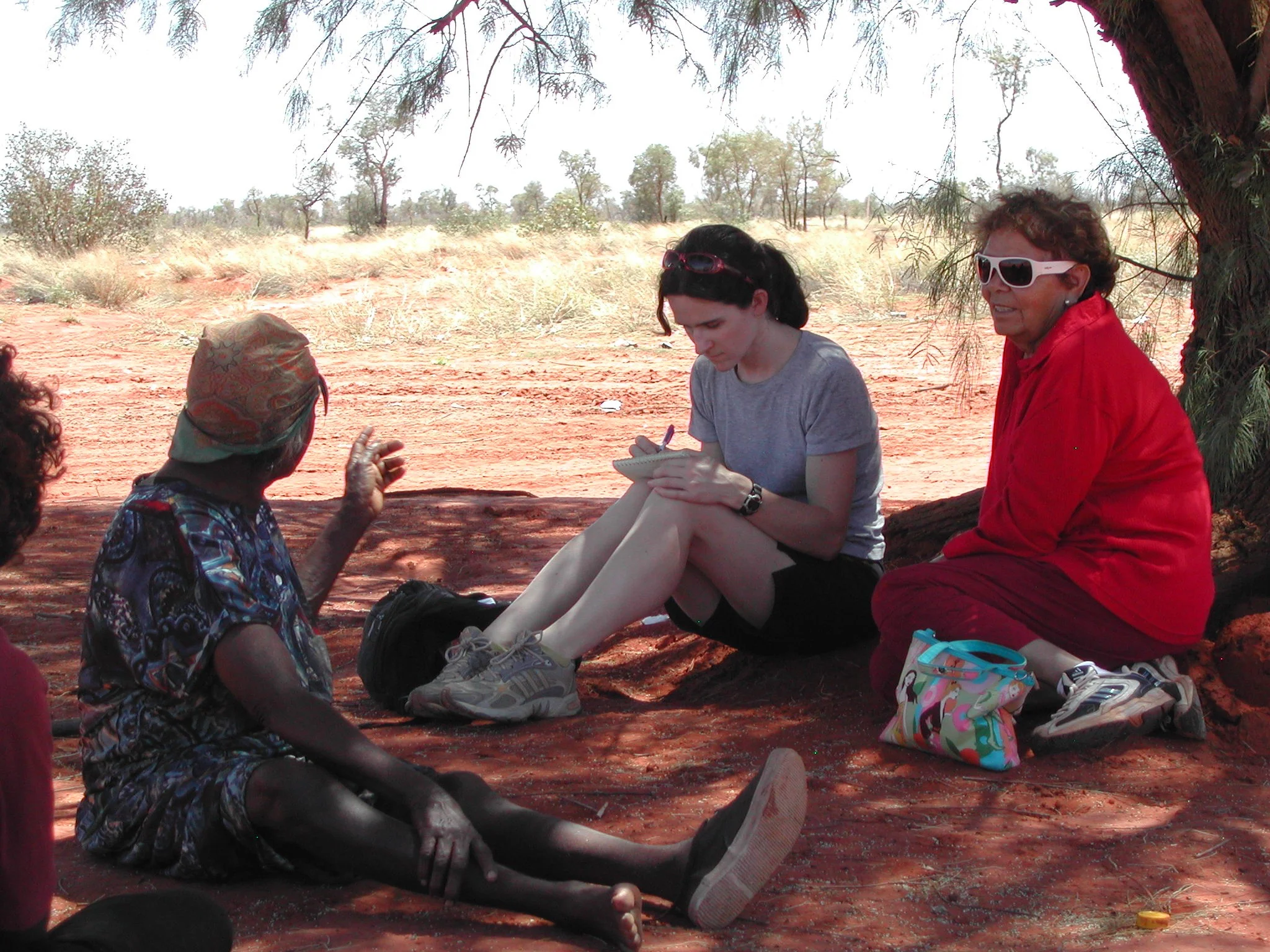
Interviewing the family of Australian aboriginal artist Barbara Weir in her mother's country, Utopia, in the Northern Territory.
When I first learned the business of storytelling at Northwestern University’s Medill School of Journalism, my professor Marcia Froelke Coburn told us about an editor who would skim through an article, roll his eyes dramatically, and groan, “Get me out of here!”
Coburn, who wrote profiles of big personalities like the Chicago Bulls’ Scottie Pippen, was trying to make a point: If you don’t make clear why your reader should care about your story, your story won’t matter. She was teaching the fundamentals of what journalists call the “nut graf”: Essential for every article, the nut graf is both the thesis statement and the journalist’s best attempt to explain why the story matters. Often, the nut graf follows a heart-tugging vignette and hits the reader with a barrage of data showing that the story in the lead is a common tale. This is happening at a large scale, the journalist is saying. It matters.
When I started my freelance editorial and communications business, I decided on a mission that speaks to what I do: Create stories that matter. For most of my career, I have created stories focused on sustainable business and corporate responsibility, social and environmental progress, health and wellness, and travel and outdoor adventure. These are stories that matter to me.
But why do they matter to me, and what makes a story matter to others? With respect to Coburn, her editor, and the prized nut graf, I believe that if we more clearly define what makes a story matter, we can write more of them, more effectively, and engage more people—which will ultimately inspire more positive change in the world. So I will try to craft a better definition here.
Love, Hate, Success, Failure, and the Other Great Truths
A few years before Coburn’s class, I took a magazine-writing course with Medill’s beloved Professor Bob McClory, who died on Good Friday this year. McClory believed there are certain Great Truths—a sort of natural law for stories—that matter to every one of us: Love, Hate, Success, Failure, Loyalty, and Betrayal. Touch on any of those themes in your story, he theorized, and your reader will care. (As if to illustrate his point, McClory’s own life story—a priest who left the church to marry a nun—covered many of the Great Truths.)
McClory’s universal truths point to what makes a story matter: These stories affect the reader. They change the way we think, act, or view the world. They connect us to something bigger, tugging us in and making us part of the story itself.
From Advocacy Journalism to Mainstream Media
In media, these stories were traditionally the domain of “advocacy journalism” outlets like my alma mater Mother Jones, but today they are becoming mainstream. Founded in 2007 to give readers the “information they need to navigate the heat and emotion of climate and energy debates,” InsideClimate News became the first digital publication to win a Pulitzer Prize in 2013. In 2014, Glenn Greenwald, Laura Poitras, and Jeremy Scahill started the Intercept as an extension of Greenwald and Poitras’ Pulitzer Prize-winning reporting on government surveillance of citizens. Also last year, Neil Barksy recruited former New York Times columnist and executive editor Bill Keller to lead the Marshall Project, which is devoted to covering America’s criminal justice system. And just this summer, former NBC and CNN anchor Campbell Brown launched the Seventy Four to cover America’s “education crisis.”
There are two hallmarks of this kind of reporting: a focus on solutions and a mission to engage the audience in the story itself. In December 2014, Sacramento’s Capitol Public Radio ran the multimedia series “Hidden Hunger” to explore food insecurity in the region. Applying the traditional nut graf definition, this story mattered: Despite living in one of the country’s richest agricultural regions, one in seven people in south Sacramento lack the money or transportation required to get the food they need. What set this series apart, however, was its focus on community engagement before, during, and after the series. As Josh Stearns detailed in Medium, Capitol Public Radio hired jesikah maria ross to “build people in from the start, craft a shared vision, develop trust, define common goals.” “Stories connect us across our differences,” ross told Stearns, who is leading a project for the Geraldine R. Dodge Foundation to, among other things, test new community-engagement strategies in journalism.
A New Brand of Corporate Messaging
It’s also becoming more common for companies to share these stories, as a way to connect with their customers through a set of shared values. The outdoor lifestyle brand Patagonia—whose mission is to “build the best product, cause no unnecessary harm, use business to inspire, and implement solutions to the environmental crisis”—recently ran an effective campaign to get its customers to fix broken gear rather than replace it with something new. Earlier this year, Chipotle, which advertises “food with integrity,” removed pork from a third of its stores due to concerns over how the animals were treated in part of its supply chain. Just this summer, the owner of the Seattle-based credit-processing firm Gravity Payments, which describes itself as “a business with values and integrity,” decided to address inequality by setting a new $70,000 minimum salary at his company.
Like the media outlets that seek to engage their readers in the story and solutions, these companies are encouraging their customers to take action. Jonah Sachs, the cofounder and CEO of Free Range studios and author of Winning the Story Wars (Harvard Business Review Press 2012), calls these companies “pro-social”: “Unlike the ‘sustainable brand’ that says ‘buy our product because we’re making it less harmfully than others,’ the pro-social brand says ‘join us in making a better society,’” he wrote in an article for the Guardian Sustainable Business. And customers are eager to hear these stories: A 2013 Cone Communications/Echo Research study of more than 10,000 respondents in 10 countries found that 91 percent of citizens want to hear about a company’s corporate social responsibility initiatives and progress.
Nonprofits Building Human Connections
Not surprisingly, nonprofit organizations have long focused on storytelling aimed at getting people to take action. But instead of simply broadcasting stories intended to get readers to write a check for a cause, some nonprofits are trying to get people involved in the story itself.
My former Business for Social Responsibility colleague Ayesha Barenblat founded the organization Remake to build connections between consumers, brands, and the people who make consumer products. Remake’s theory is that consumers who connect on a human level with the “makers” of their stuff will be more inclined to select products from companies that treat these makers humanely. “Today, there is a long, unhappy story of how our stuff is made and where it ends up,” Barenblat wrote about the idea behind Remake. “I want us to reimagine that story. I founded Remake because I truly believe in the good that comes from human connections.”
My Business and the Life I Want
It’s inspiring to me that the creators of stories that matter are no longer just journalists but the thoughtful leaders of nonprofit organizations and businesses alike. That’s why I am using my business to create stories that matter, as a journalist and as a communications consultant for nonprofit organizations and businesses that want to inspire positive change in the world.
I also will be telling some of these stories in my blog, starting with a series, “The Life I Want,” profiling people who have made a conscious decision to craft the life they want—both personally and professionally. Crafting the life I want is exactly what I’m doing with my business, and I hope this series inspires others to follow suit. Stay tuned.