creating stories that matter

Life I Want: Rick Ridgeway
Rick Ridgeway turned his passion for mountain landscapes and environmental conservation into a life as a mountaineer, writer, photographer, filmmaker, and, today, vice president of public engagement at the outdoor company Patagonia.

Photo of Rick Ridgeway on Antarctic expedition courtesy of Gordon Wiltsie: www.alpenimage.com.
Name: Rick Ridgeway
Occupation: Mountaineer, author, photographer, filmmaker, and vice president of public engagement at Patagonia
What’s your superpower? “It’s very connected to having a passion. If you have a passion, how do you activate that? How do you use it as a framework to make your decisions? If you don’t do that, you are probably not going to realize your passion. Looking back on it, I think the attribute I used most effectively was tenacity. I developed a tenacious commitment to do what it took to realize my passion. And it worked for me.”
About this series: This blog series profiles people who have made a conscious decision to craft a life that allows them to meet their personal and professional aspirations. The series is intended to celebrate those who are living the life they want and inspire others to do the same. Also, I ask everyone about their superpower, a question inspired by Ruth Ozeki’s great, great book A Tale for the Time Being.
When I interviewed Rick Ridgeway last October, he had just returned home from a short trip to Boulder, Colorado. He told me that as the plane flew over San Gorgonio, Southern California’s highest peak, he was thinking about when he first went to that mountain in high school. It was 1966, Ridgeway was 16, and he was inspired to learn to climb after seeing a National Geographic cover photo of Jim Whittaker holding the American flag at the top of Mt. Everest—the first American to climb the world’s highest mountain.
“I thought, I want to be that guy,” Ridgeway told me. “So I went out and bought an ice ax, some Italian boots, and the book Freedom of the Hills. And I went up San Gorgonio and taught myself how to use the ice ax and crampons.”
That was the moment Ridgeway made a personal commitment to pursue his passion. “I said, I’m never going to give up on this,” Ridgeway said. “And 12 years later, I was on the first ascent of K2, and the leader of the group was Jim Whittaker.” This time, Ridgeway was standing alongside Whittaker on the cover of National Geographic.
Twenty years later, on an expedition to Antarctica with Alex Lowe and Conrad Anker, the team was holed up in their tent waiting out a storm when Anker told Ridgeway that his cover photo had inspired Anker’s own passion for mountaineering. “Conrad said, ‘You know, Rick, I haven’t told you this, but when I was younger, I had been thinking about climbing, and I got my National Geographic with you on the cover, and I thought, that’s it, I’m going to be that guy,’” Ridgeway said. “We got back from that trip, and I got my National Geographic, and there’s Conrad Anker on the cover, and I told Conrad, somewhere, there’s a young guy who’s saying, ‘I want to do that. I want to be that guy.’”
On the flight, Ridgeway said he was trying to imagine what it would be like if his 16-year-old self could have known that 50 years in the future, this grey-haired man would look over that same mountain and recognize that his life’s path started there. “It all began with this commitment to a passion—a real commitment, an unwavering commitment,” Ridgeway said.
From Hobby to Professional Path
Ridgeway pointed out that he has held a “regular job” for only the past 12 years as a full-time employee at the outdoor company Patagonia. “The main reason I never worked for a company is that I never imagined myself being able to fit into a corporate environment,” he said. To be sure, Patagonia is a unique company with an anti-corporate culture whose spirit is captured in founder Yvon Chouinard’s philosophy, “Let my people go surfing.”
Before settling into his role as vice president of public engagement at Patagonia, Ridgeway made a life as a mountaineer, photographer, author, and filmmaker. His interest originated when, as a teenager, he went to the mountains to escape what he describes as “the destruction around me,” as developers transformed the rural agricultural landscape of Orange County into row after row of tract houses.
As he got older, he decided to turn his hobby into a professional pathway. “I realized that I needed to find a way to pursue my occupational life in a way that embraced by vocational life,” he said. He started by pursuing photography and writing. When Ridgeway was in his 30s, he opened his own business representing photographers and filmmakers who sold their work for commercial purposes. At the height of this business, Ridgeway had 20 employees and represented 160 people.
First ‘Regular’ Job
He sold his company in 2000 and then went on to pursue his own filmmaking, writing, and photography. In 2003, he joined the Patagonia board, and in 2004 he was offered a full-time job.
“They invited me to become an employee, and I had never thought about that,” Ridgeway said. “They needed somebody to oversee environmental initiatives and to communicate their environmental commitments without being misunderstood and charged with greenwashing, and that sounded like a cool challenge.”
As an old friend and climbing partner of Chouinard’s, Ridgeway also understood that Patagonia had a different ethos and respected the need for employees to have work-life balance. In addition to its famed powder and surf clause, Patagonia has offered on-site childcare since 1982, when Chouinard’s wife, Malinda, and Ridgeway’s wife, Jennifer, who cofounded Patagonia’s marketing department, set up a trailer staffed with a babysitter at the headquarters. (The daycare center is now an impressive child-development center that teaches kids to take safe risks and become confident in their own abilities.)
Ridgeway says this approach has helped build the company’s core culture and helped Patagonia retain employees. “Life has a better chance of being meaningful if we find a balance between our work and personal life that feels right for us,” he said. “Then people will enjoy coming into work and they will be passionate about their life in work and outside of work.”
Given the philosophy of Patagonia’s founder, it is not surprising that the company culture is what it is. What is surprising is that more companies don’t realize that to attract people like Ridgeway, the culture of the organization is paramount—though Ridgeway says that is changing. “The common challenge for other companies is self-limitation: thinking that principles like this will cost money—that it will cost the company to give their employees a better work-life balance,” he said. “We have discovered that that’s not true. We have such a committed workforce that the loyalty from employees provides significant value to the company. It’s as simple and basic as the fact that when employees are happy, they get more work done. Teamwork gets stronger, and the overall commitment from employees is as strong as it could conceivably be.”
A Commitment to the Last Step
Ridgeway is generous in sharing his story, which has not been without hardship. Like anyone trying to carve out their own path, he has experienced financial challenges. And like many professional mountaineers, he has experienced tragedy. “There’s always going to be road bumps, and some of them get pretty big,” he said. “The biggest one in my life was getting in an avalanche in 1980 when my best friend died in my arms, and then finding the inner strength to recommit—that was really hard to do.” (A few months after I spoke with Ridgeway, he experienced a similar tragedy when North Face Founder Doug Tompkins drowned in a kayaking accident that Ridgeway survived. Ridgeway wrote about the experience in a Patagonia blog entitled “To Those Who Loved Doug.”)
It would be remiss to tell Ridgeway’s story without mentioning that he is married and has three children. “I had an unusual career path because I retired first, which was cool. I figured it out,” he said. “But the real hero in this story is my wife. She’s the one who raised our three kids while I was out being a professional climber, and that’s how I created income for our team. But, boy, she gets the credit for holding down the fort.”
The two have been married for more than 30 years, and Ridgeway said they went into this life together with a mutual understanding: “We committed to each other without all the answers.”
This lack of knowing what’s next is one of the reasons Ridgeway titled his book about the ascent of K2 The Last Step, which references a passage in Rene Daumal’s Mount Analogue. “There’s a quote in there: ‘The last step depends on the first,’” Ridgeway said. “You have to commit. You don’t have all the answers, and you won’t get to the last step until you commit to the first step. It’s knowing that the first step depends on the last, and the last step depends on the first. It works both ways, and it requires you to envision the whole thing.”
Inspired by 1% Percent for the Planet: Why I Gave to Mt. Ashland and Outdoor Afro
In 2015, I successfully launched my own freelance business. Inspired by 1% for the Planet, I chose to give 1 percent of my business revenue to two causes: Mt. Ashland and Outdoor Afro. Here's why.

Early days skiing gates.
In 2002, Patagonia founder Yvon Chouinard and a buddy of his, Craig Matthews, who runs the Yellowstone fishing outfitter Blue Ribbon Flies, launched a business philanthropy program called 1% for the Planet. Both of these guys understand that their business depends on nature, and they devised a way to give back. They figured that by starting a platform to donate 1% of their annual sales to programs that support things like climate progress and wildlife conservation, likeminded businesspeople might be inclined to join them.
They were right. Today, more than 1,200 companies from 48 countries have donated more than $100 million to environmental causes through 1% for the Planet.
While my own small business is not among the companies that get the honor of printing 1% for the Planet’s iconic blue logo on their products (I’ll be investigating membership in the future), this program inspired me to give 1% of the revenue I earned since starting my business in September 2015. I gave to two causes: Mt. Ashland, the community-owned ski area where I took my first turns, and Outdoor Afro, a program started by one of my Oakland neighbors, Rue Mapp, to celebrate and inspire African-American connections and leadership in nature.
Before I started my business, I thought I would have some extra time on my hands. To put it more bluntly, I didn’t think I would generate as much paying work as I have been able to. Not wanting to be idle, I put together a pie chart for how I would spend my time: One wedge would be work that would generate the income my family and I needed to live on, another wedge would be work that paid a little less but represented work I liked to do, and the third wedge would be work that might not pay the bills but that would fulfill my passion or give back to causes I care about. Ideally, I would eventually earn a living in that third wedge. That rudimentary pie chart was my business plan.
As it happens, I have had the privilege of spending most of my working hours in that third wedge, helping tell stories that matter on responsible business, girls education, climate change, protecting our oceans, investing in ecosystems, exploring the role of media in India’s sustainability, building the livelihoods of people in the Muslim world, and more.
During my vacation at the end of 2015, I had the chance to reflect on the unexpected success of my business launch. While I had planned to “give back” through pro bono work throughout the year, I didn’t end up having the time to do that. Instead, I found myself in the position to give a little back financially.
Here’s why I chose to divide my own “one percent for the planet” between my home hill of Mt. Ashland and my neighbor Rue Mapp’s Outdoo Afro.
All Lines Lead Back to Mt. Ashland
Located in the Siskiyou Range of Southern Oregon, 7,533-foot Mt. Ashland has always had a significance in my life disproportionate to its stature. Mt. Ashland won over Telluride, Colorado, as the mountain that brought my dad West when he was looking for small ski towns where he could raise his kids and practice medicine. Every winter weekend, my dad piled us into our brown Suburban and then swung by the Hammock’s and the Dunlevy’s houses to pick up my brother’s friends before driving up to the mountain for training with the Mt. Ashland Racing Association. We spent our summers raising money for season passes and weight training in our garage so we could keep up with my dad on the moguls.
As I got older, several bad ski years prompted my family to give up our passes at Mt. Ashland and instead drive three hours to the higher-elevation Mt. Bachelor in Central Oregon. But I still spent much of my youth in the shadow of Mt. Ashland, racing cross-country track in the fall against the unbeatable Ashland High School girls team and spending summer weekends mountain biking on the logging roads that flank Mt. Ashland’s lower slops.
By the time I got to high school, year after year of warm, dry winters left Mt. Ashland near bankruptcy, and the owner threatened to dismantle the lifts and use them at his other mountain, Washington’s Steven’s Pass. In 1992, the community rallied around a “Save Mt. Ashland” fundraising campaign and successfully transformed the ski area into a nonprofit (the High Country News has a great profile of Mt. Ashland’s nonprofit model).
Over the years, though, the relatively low-elevation mountain has suffered due to global warming, and in January 2014, the mountain canceled plans for its 50-year-anniversary celebration and held a “Pray for Snow” party instead. The mountain did not open at all that year due to lack of snow, and season pass holders were given the option of getting a refund or donating the cost of their pass to keep the ski area afloat.
I was thinking about Mt. Ashland when I attended the COP21 climate talks in Paris in December. The week before the Paris Agreement was signed, I sat in on a panel discussion hosted by Al Gore’s Climate Reality Project and Protect Our Winters (which goes by the clever acronym “POW”), an organization founded by big-mountain snowboarder Jeremy Jones to raise awareness within the winter sports community about how climate change is affecting our fun.
A lot of the discussion on this panel revolved around how POW can influence affluent skiers with second homes in places like Aspen, a much more famous ski town than Ashland that, impressively, is one of three U.S. cities to run on 100 percent renewable energy. While I agreed with the end goal—to get more people to act on climate change—I was frustrated with the focus on the wealthy. We don’t just need the people of Aspen to care and act and vote to protect our climate; we need action by the people of Medford and Grants Pass and other working-class towns like the ones surrounding Mt. Ashland.
I believe that by getting more people out skiing and hiking and mountain biking at places like Mt. Ashland, we’ll have more people devoted to protecting our environment. With a goal to “provide fun and enjoyment for all demographics and social classes,” Mt. Ashland gets half of my one percent this year.
Rue Mapp and Outdoor Afro: Changing the Face of Conservation
Although I have not yet had the chance to meet Rue Mapp, I have encountered her on Twitter, via her writing on her blog, and in person at Oakland’s Redwood Park, where she has led hikes for Outdoor Afro and where my family and I go several times a week to run the trails and build forts in the forest.
In 2009, Mapp founded Outdoor Afro, whose cheeky tagline, “where black people and nature meet,” is a reference to a much more significant purpose: The group’s 30 leaders across the United States connect thousands of people to outdoor experiences. And those people are, as she writes on her website, “changing the face of conservation.” Her invitation is inspiring: “Come out in nature with us, or be a partner to help us grow our work so that we can step into our destiny to lead the way for inclusion in outdoor recreation, nature, and conservation for all!”
For me, Mapp’s words recall those of the African-American writer Eddy Harris, who wrote a beautiful essay for Outside magazine almost 20 years ago: “The natural world is neither black nor white. It is forest green, desert ocher, deep ocean blue. If there are barriers that keep us all from immersing ourselves in it and savoring its riches, they may be reducible, in part, to economics, to geography, to history, and to culture. But mostly they exist in our minds, in the fears and misperceptions that continue to keep us suspended in our separate limbos, unable to come together, even in a place as universally inviting as the world outside our doors.”
Mapp’s enthusiasm is infectious, and I love her group’s mission to get more people from more walks of life to experience the great outdoors. We need more people like her, so the second half of my 2015 one percent goes to Outdoor Afro.
Did you donate money or time to a cause last year? Please share your story in the comments field. I’d love to hear what inspired you, and which efforts you are investing in.

Creating the Life I Want—and a New Blog Series
More than a third of all Americans today gain income from freelance work. And with telecommuting and flexible work schedules, even traditional employment is changing. How can you craft your work to create a fulfilling life? My new blog series—profiling people who are creating the life they want—provides a playbook on how to do this.

Our new house in Australia, in the vineyard, among the roos and cockatoos.
Shortly after my 25th birthday, I was sitting in the People’s Café on San Francisco’s Haight Street, drawing a rudimentary pie chart to show my friend Monica the things I needed in my life for balance. My chart had three wedges:
People, for proximity to my friends and family.
Place, for my physical home and how close that home was to the backcountry.
Profession, for job fulfillment and income.
It was the year 2001, the environmental news site I had been editing for had folded, and I was about six months into a job as an editor at the investigative reporting magazine Mother Jones. I was earning less than $28,000 per year, a low figure even in those times.
Monica and I were planning our futures, and my pie chart was intended to put in perspective why I could afford to take such a low-paying gig.
Profession: I believed the kind of journalism we were doing at Mother Jones was meaningful work.
People: I had plenty of friends, and my family was just a five-hour drive up I-5.
Place: My daily trail run in the Berkeley Hills, where I lived at the time, was just two miles away.
Still, I was thinking about how I could change my situation to spend more time outside. Maybe I could do a job share at Mother Jones and start up a dog-walking/freelance-writing business on the side?
For reasons I can’t quite understand now, I decided I wouldn’t be able to match my meager salary working for myself, and I filed away my plan to go freelance.
Fast-forward 15 years. With me nearing 40, my twins nearing 5, and my husband, Adam, nearing 50, my family and I have decided to radically change our lives. For the past 10 years, Adam has been developing a vineyard and making his own wine from a rural property two hours west of Melbourne in his native Australia, and we planned to move our family there. He would leave his corporate winemaking job to become a winemaker/farmer/dad, and I would leave my communications job at an international nonprofit organization to become a writer/editor/mom.
People: Great friends in our new town of Great Western, which is just a five-hour flight from Adam’s family in Perth.
Place: Half hour from some of Australia’s best rock climbing in the Grampians National Park. Home off a red dirt track surrounded by vines, roos, and cockatoos.
Profession: We both get to work for ourselves, even if we do have to live the life of a poor farmer and a hungry writer.
The ‘Eva Model’
While we had always planned to move to Australia, the decision for me to go freelance while still living in the United States happened gradually. About a year ago, I was going through the onerous task of writing my annual goals. I loved my job, but I dreaded the chore of conjuring up a target number of media hits we should earn, or the ideal number of climate-focused blogs we should publish. I started to wonder: What if I set goals that were meaningful to me? Like, run as many miles as I work hours per week, giving new meaning to the term “miles per hour.” Or walk my kids to their new school every day.
Once I started, I couldn’t stop: Play a Scott Joplin piece, straight through, on the piano. Spend more nights sleeping in a tent. Teach the kids to ski on my home hill, Mt. Ashland. Better yet, let my dad teach them to ski, while Adam and I take some telemark turns down the Ariel chairline. Write my own blog (check).
That weekend, Adam and I got the kids a sitter and hashed out our plans over dinner: We couldn’t afford for me to leave my job until the kids started public school, which they would do in September of 2015. Then I could ramp up my freelance business and still have more time to spend with the kids. We would move to Australia in September of 2016.
Two months before I left my job, I worked closely with my boss and my team to ensure a smooth transition. We discussed responsibilities I could continue as a freelancer, which gave the team more time to think about how and whether to fill my position, and gave me a solid pipeline of work to start my business.
After I left my job, a couple of my other colleagues took a similar route, leaving their full-time positions and consulting back to the organization to do some of the work they had previous led. One friend told me people have started to refer to this as “the Eva Model.”
The New Gig Economy
I might have launched a trend at my old workplace, but the Eva Model is pretty common these days. According to an article Freelancers Union Founder Sara Horowitz published in the Bureau of Labor Statistics’ Monthly Labor Review, more than 53 million Americans—one in three workers—are now earning income from work that’s not a traditional 9-to-5 job. It’s not just the advent of the gig economy that has made it easier to follow the Eva Model. With social networks, it’s easy to find organizations that need skills and experience you can offer, even if you’re an ocean away from their headquarters.
When I started developing my freelance business, I discovered a whole world of these people, several of whom have jobs that primarily service the freelance community. I hired a freelance designer to help me set up my website and a Mac expert who sorted out my IT systems. I sought advice from a friend who helps people become influencers on social media, and another friend who writes/edits/dads (a profession my writer/editor/yoga-teacher friend refers to as being a “slasher”).
For a story assignment, I interviewed another woman who blogs/writes/hosts-videos on money and is now writing an ebook on personal finance. At my kids’ new preschool, I met a pregnant mom of two whose Swiss Cheese Childcare business helps busy parents find pre-approved sitters on short notice. I met another mom who shares a job teaching the second grade in a local public school and spends the rest of her time raising her twin boys and volunteering at the school.
Meeting this community got me thinking about the common theme among all of these individuals: They are each crafting the life they want. And even though it’s now easier than ever to dip into the gig economy and create the life you want, there’s no playbook on how to do it.
I decided to write one.
Creating the Life You Want: My New Blog Series
Two years before I was born, the oral historian Studs Terkel published the book Working, a series of interviews with people talking about what they do all day, and how they feel about it. He spoke with more than 100 people—a waitress, a cab driver, a farm worker, a sports executive, a press agent, and many more—and the resulting work has become a favorite of many people, mainly because Terkel profiled real people, using their own words.
I bring him up here to, in modern-day parlance, give Terkel a hat tip, for I wish to follow in his footsteps with my blog new series, profiling real people, and their efforts to create the lives they want. Forty years after Terkel’s book was published, people still spend the bulk of their time at work, so my focus in this blog series is how people are creating the lives they want through their work.
Given the changing nature of the workforce, this is a relevant time to explore the subject. In addition to the increasing number of people who are earning incomes from nontraditional work, the workforce itself is transforming. According to a Gallup survey published in August, 37 percent of Americans now telecommute for work, up from 9 percent in 1995. Interestingly, a 2013 Gallup article reported that although most remote workers log more hours, they are more engaged at work.
Employee engagement is an important dimension in the workplace because it influences productivity, which affects an organization’s performance. But Gallup reports that only 13 percent of workers worldwide are engaged in their jobs. In the United States, the figures are slightly better: 30 percent of workers are engaged, but a surprising 18 percent—nearly one in five people—are actively disengaged, which Gallup defines as emotionally disconnected from work, unproductive, and potentially hostile.
The good news is that more companies are beginning to recognize that employee satisfaction is important, and those places are focused on developing workers’ strengths and enhancing their well-being—two of the three main factors Gallup says are most influential in employee engagement. And, of course, employees who are unhappy in traditional roles now have more opportunities to create their own niche working for themselves.
I believe the nature of the workforce is changing, and that 10 years from now, more people will be self-employed, while others will work for traditional employers who are offering flexible work opportunities that allow people to be both more engaged in their work and more engaged in their homes and communities. I envision a future where people are leading the lives they want, creatively building their professional career around what they really want to achieve in life, in work, or in the world.
But because this is a wide-open field, and there’s no single playbook, some people may struggle with how to craft this life. My new blog series is for them—to celebrate those who are living the life they want, and to inspire others to do the same.
Already, I have interviewed a number of interesting people: the father of Australia’s most famous country singer, who took his young family out for a three-week camping trip in the Outback—and ended up staying there for 10 years; a Harvard Business School-trained venture capitalist who spent the past 10 years fundraising and connecting with people around the globe to build a hospital in rural India; and a former Medill classmate of mine who has been freelancing for his entire professional career—the trigger for his decision was when a source pulled a gun on him.
In this blog series, I will profile people from all walks of life to chronicle how they have created the life they want, what has gone well, and what hasn’t.
When Things Don’t Go to Plan
Two weeks after I started my freelance business, on September 11, Adam was “restructured” out of his job a year earlier than expected. In our scenario-planning, we had been thinking about a plan B for our Australia life: What if we don’t sell enough wine, what if the Aussies don’t want to hire an American editor, what if climate change, drought, late payments on wine sales, late checks on writing assignments. We didn’t plan the “what if” for our last year in America.
But here’s the thing: Even when you are leading the life you want—even when you are spending more time running or practicing Scott Joplin or reading the kids E.B. White—things don’t always go to plan.
Since the news about Adam’s job last month, we have adjusted our plans. We will leave for Australia a few months early. I will take on more freelance work. He will be the one walking the kids to and from school. I will have a house-husband. He will have a breadwinner. The kids will have two parents who are more fulfilled in life and around a lot more often. With luck, we’ll all have the life we want.
Now I have to run—literally. I have at least 35 miles to log this week if I want to meet my goals.
What Are Stories That Matter?
Stories that matter engage us in the story itself—changing the way we think, act, or view the world.

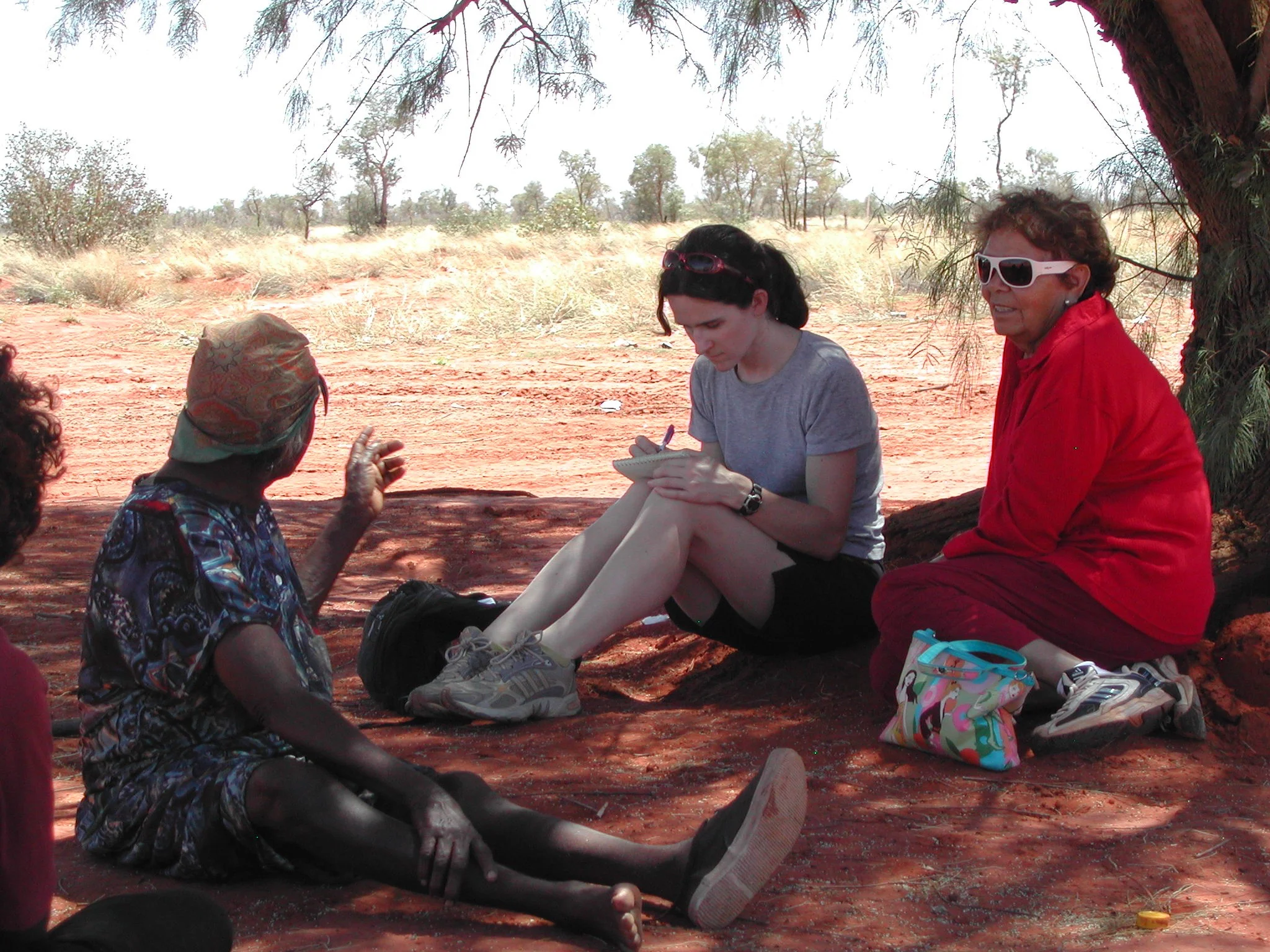
Interviewing the family of Australian aboriginal artist Barbara Weir in her mother's country, Utopia, in the Northern Territory.
When I first learned the business of storytelling at Northwestern University’s Medill School of Journalism, my professor Marcia Froelke Coburn told us about an editor who would skim through an article, roll his eyes dramatically, and groan, “Get me out of here!”
Coburn, who wrote profiles of big personalities like the Chicago Bulls’ Scottie Pippen, was trying to make a point: If you don’t make clear why your reader should care about your story, your story won’t matter. She was teaching the fundamentals of what journalists call the “nut graf”: Essential for every article, the nut graf is both the thesis statement and the journalist’s best attempt to explain why the story matters. Often, the nut graf follows a heart-tugging vignette and hits the reader with a barrage of data showing that the story in the lead is a common tale. This is happening at a large scale, the journalist is saying. It matters.
When I started my freelance editorial and communications business, I decided on a mission that speaks to what I do: Create stories that matter. For most of my career, I have created stories focused on sustainable business and corporate responsibility, social and environmental progress, health and wellness, and travel and outdoor adventure. These are stories that matter to me.
But why do they matter to me, and what makes a story matter to others? With respect to Coburn, her editor, and the prized nut graf, I believe that if we more clearly define what makes a story matter, we can write more of them, more effectively, and engage more people—which will ultimately inspire more positive change in the world. So I will try to craft a better definition here.
Love, Hate, Success, Failure, and the Other Great Truths
A few years before Coburn’s class, I took a magazine-writing course with Medill’s beloved Professor Bob McClory, who died on Good Friday this year. McClory believed there are certain Great Truths—a sort of natural law for stories—that matter to every one of us: Love, Hate, Success, Failure, Loyalty, and Betrayal. Touch on any of those themes in your story, he theorized, and your reader will care. (As if to illustrate his point, McClory’s own life story—a priest who left the church to marry a nun—covered many of the Great Truths.)
McClory’s universal truths point to what makes a story matter: These stories affect the reader. They change the way we think, act, or view the world. They connect us to something bigger, tugging us in and making us part of the story itself.
From Advocacy Journalism to Mainstream Media
In media, these stories were traditionally the domain of “advocacy journalism” outlets like my alma mater Mother Jones, but today they are becoming mainstream. Founded in 2007 to give readers the “information they need to navigate the heat and emotion of climate and energy debates,” InsideClimate News became the first digital publication to win a Pulitzer Prize in 2013. In 2014, Glenn Greenwald, Laura Poitras, and Jeremy Scahill started the Intercept as an extension of Greenwald and Poitras’ Pulitzer Prize-winning reporting on government surveillance of citizens. Also last year, Neil Barksy recruited former New York Times columnist and executive editor Bill Keller to lead the Marshall Project, which is devoted to covering America’s criminal justice system. And just this summer, former NBC and CNN anchor Campbell Brown launched the Seventy Four to cover America’s “education crisis.”
There are two hallmarks of this kind of reporting: a focus on solutions and a mission to engage the audience in the story itself. In December 2014, Sacramento’s Capitol Public Radio ran the multimedia series “Hidden Hunger” to explore food insecurity in the region. Applying the traditional nut graf definition, this story mattered: Despite living in one of the country’s richest agricultural regions, one in seven people in south Sacramento lack the money or transportation required to get the food they need. What set this series apart, however, was its focus on community engagement before, during, and after the series. As Josh Stearns detailed in Medium, Capitol Public Radio hired jesikah maria ross to “build people in from the start, craft a shared vision, develop trust, define common goals.” “Stories connect us across our differences,” ross told Stearns, who is leading a project for the Geraldine R. Dodge Foundation to, among other things, test new community-engagement strategies in journalism.
A New Brand of Corporate Messaging
It’s also becoming more common for companies to share these stories, as a way to connect with their customers through a set of shared values. The outdoor lifestyle brand Patagonia—whose mission is to “build the best product, cause no unnecessary harm, use business to inspire, and implement solutions to the environmental crisis”—recently ran an effective campaign to get its customers to fix broken gear rather than replace it with something new. Earlier this year, Chipotle, which advertises “food with integrity,” removed pork from a third of its stores due to concerns over how the animals were treated in part of its supply chain. Just this summer, the owner of the Seattle-based credit-processing firm Gravity Payments, which describes itself as “a business with values and integrity,” decided to address inequality by setting a new $70,000 minimum salary at his company.
Like the media outlets that seek to engage their readers in the story and solutions, these companies are encouraging their customers to take action. Jonah Sachs, the cofounder and CEO of Free Range studios and author of Winning the Story Wars (Harvard Business Review Press 2012), calls these companies “pro-social”: “Unlike the ‘sustainable brand’ that says ‘buy our product because we’re making it less harmfully than others,’ the pro-social brand says ‘join us in making a better society,’” he wrote in an article for the Guardian Sustainable Business. And customers are eager to hear these stories: A 2013 Cone Communications/Echo Research study of more than 10,000 respondents in 10 countries found that 91 percent of citizens want to hear about a company’s corporate social responsibility initiatives and progress.
Nonprofits Building Human Connections
Not surprisingly, nonprofit organizations have long focused on storytelling aimed at getting people to take action. But instead of simply broadcasting stories intended to get readers to write a check for a cause, some nonprofits are trying to get people involved in the story itself.
My former Business for Social Responsibility colleague Ayesha Barenblat founded the organization Remake to build connections between consumers, brands, and the people who make consumer products. Remake’s theory is that consumers who connect on a human level with the “makers” of their stuff will be more inclined to select products from companies that treat these makers humanely. “Today, there is a long, unhappy story of how our stuff is made and where it ends up,” Barenblat wrote about the idea behind Remake. “I want us to reimagine that story. I founded Remake because I truly believe in the good that comes from human connections.”
My Business and the Life I Want
It’s inspiring to me that the creators of stories that matter are no longer just journalists but the thoughtful leaders of nonprofit organizations and businesses alike. That’s why I am using my business to create stories that matter, as a journalist and as a communications consultant for nonprofit organizations and businesses that want to inspire positive change in the world.
I also will be telling some of these stories in my blog, starting with a series, “The Life I Want,” profiling people who have made a conscious decision to craft the life they want—both personally and professionally. Crafting the life I want is exactly what I’m doing with my business, and I hope this series inspires others to follow suit. Stay tuned.