creating stories that matter

Gender Equality Begins at Home
Gender equality at home affects gender equality at work and vice versa. It's time we started talking about it—at home, at school, at work, and maybe even on live television.

I took a break from doing the laundry to write about gender equality in the home. Here's my family's (clean) laundry, airing.
This is the third blog in a series on what I learned during one year focusing on gender equality in my life and work.
Without airing all of our dirty laundry, I will say that the thing Adam and I bicker about most as husband and wife is domestic responsibilities. I don’t think we’re alone. In Australia, the latest census data show that employed women do more housework than employed men: In 2016, the average man did less than five hours of domestic work per week, while the average woman put in between five and 14 hours looking after the house and the kids, gardening and cooking, getting groceries and cleaning. (Interestingly, it appears that when men get wives, they start doing less housework, as the number of hours spent on chores is closer to equal for single men and women.)
Gender inequality at home is what inspired Gemma Hartley to write her Harper’s Bazaar article last year entitled “Women Aren’t Nags, We’re Fed Up.” The image accompanying her article shows a dish-glove-clad woman’s hand giving the finger. I stumbled upon this brilliant piece from a post by Melinda Gates on LinkedIn. (I found it strangely comforting to imagine Melinda and Bill Gates squabbling about whose turn it is to do the laundry.) This article struck a chord with me because of what our modern, supposedly equal families are teaching our kids. As Hartley wrote: “Unless I engage in this conversation on emotional labor and actively change the roles we inhabit, our children will do the same.”
Here’s the thing: Changing cultural gender roles takes time, it starts at home, and we’re not talking about gender inequality at home—with our families, at school, at work, or in the media. This is a problem.
When I first met Adam, we didn’t talk about division of household labor. Who does? That’s got to be the world’s most unromantic topic of conversation. We didn’t even talk about it during the three years we spent trying to get pregnant. By the time we were mooning over our newborn twins, we lost our chance. When you’re in the thick of parenting, particularly when you both work, you have very little time to talk about who does what. And so we fall back on what we know—what we saw modeled by our parents in our homes decades before.
My upbringing was rather unusual, at least for the early ‘80s. After my parents’ divorce, my mom made the decision to move five hours north, to Portland, Oregon, to attend medical school. My brother and I stayed in Southern Oregon with my dad. So my model for the role of the father was my dad, who showed up to all of my soccer games, volleyball matches, cross-country and track races, and speech-and-debate competitions. Dad monitored our homework and chores. And on weekends, he packed our ski stuff, dressed us in our long underwear, and sent us to sleep in the way back of our Suburban. At 4:30 in the morning, he got in the car and started the three-hour drive to Mt. Bachelor, where he unloaded groggy, cranky kids, and taught us how to ski. (This was back when it was acceptable to have your kids sleep in the back of a cold car parked outside in the middle of winter.) Adam’s father, while involved, was more distant, and his parents’ roles were more traditional.
Perhaps because of the fact that I was raised by my dad, I have been thinking about gender roles at home since long before I got married and had a family. In college in 1995, I put together a project I called “Having It All: An Oral History of Three Women Journalists.” I wanted to learn how personal matters affected my professors’ career decisions, and vice versa.
With tears in her eyes, one professor told me she had quit her promising newspaper career so she could look after her young children. Years later, she returned to the paper to show her son around, and her old editor said, “You know, your mother was the best reporter we had.” The compliment made her wonder where she would be if she hadn’t quit. Another professor told me she turned down her husband’s first marriage proposal because she was “obsessed” with her job and felt pressure to prove herself to her male colleagues. She went on to become one of the first female managing editors of a major metropolitan daily paper. She married her husband 10 years after his first proposal, and they never had children. The third professor, who was about 15 or 20 years younger than the other two professors, worked as a broadcast news reporter for almost 10 years before quitting to teach journalism so she could spend more time with her kids.
I pursued this project because I wanted to understand how we should be talking about gender equality in the home. I wondered whether university classrooms should be a forum for discussion about the tension between personal and professional goals. I concluded that they should be. “Perhaps then it won’t be considered a ‘woman’s issue,’ but a part of life accounted for within the field of work,” I wrote.
Re-reading my paper now, I’m surprised by how I was thinking about the world of work at 19 years old. Today, as a working mother who most definitely does not “have it all,” I have had a number of conversations with friends and colleagues about home gender dynamics and how they affect their work. More than one friend has complained that while both spouses work, the woman is primarily responsible for organizing play dates, summer camps, and the school calendar. Last year, I was in the middle of a work call when I could hear my colleague’s child start wailing. Then her husband rushed in, and a tense conversation ensued. Having been in similar situations, I could imagine the words exchanged: Why aren’t you looking after the kid while I’m working?!? Afterward, she sent me a wry email: “Women's leadership begins at home, and I have none.”
What happens at home matters, and not just because it affects our personal relationships. It also affects how we contribute at work, and our opinions about gender roles shape office culture, policies, expectations, and biases.
In my research this year, I learned that not only is there a glass ceiling, there’s a “maternal wall.” Amy Nelson, an entrepreneur with three kids, wrote about this in a recent column for the Washington Post. She cited research revealing that while women are 15 percent less likely to be promoted than men, mothers are half as likely to advance than women without children. (The same research found that women with kids are 79 percent less likely to be hired in the first place.) Nelson ended up quitting her job as a corporate litigator to start her own company because she was tired of having to defend her ability to work and be a mom.
These norms affect men, too. Less than 20 percent of American workplaces offer paid paternity leave, and one study found that more than a third of men said they would not take leave due to concerns about how it would affect them at work. When I had kids and still worked full time, I arranged a flexible schedule so that I could work at home two days per week. Adam, meanwhile, had a hard time convincing his employer that international travel and after-work drinks were more difficult for him as a dad. Social institutions and norms also prevent dads from participating in ways they want to. Kevin Shafer, a sociology professor at Brigham Young University wrote an article in the Conversation about how programs like childbirth classes rarely address the role of the father beyond suggesting that they support the mother.
In reflecting on the paper I wrote back in 1995, my professor, Dick Schwarzlose, wrote a long and thoughtful missive about his own decision to take a step back from work and spend more time with his young family. As a result, he wrote, it took him 25 years to complete his two-volume history of wire services. While he said he never regretted his “reduction in production,” he said many of his male friends and colleagues regretted spending so much time at work: “I don’t know how many times (even from professors) I’ve heard men in their older years regret not having spent more time with their kids and wives. Often too little, too late.”
Last year, the work-and-home gender dynamic went viral when the BBC was conducting a live interview on Korean politics with a professor who was working from home. In the middle of the interview, the professor’s two kids busted through the door, followed a few seconds later by his frantic wife, who quickly corralled the kids. Let’s take a moment to appreciate this woman’s feat: She ran into the room, crouching low to avoid the camera lens, and grabbed the toddler by the arm, while dragging the baby backward in his walker. I’m pretty sure she didn’t have three arms, but she somehow managed to open the door behind her without releasing either kid. Then she ushered out both kids and shut the door behind them. Since this is on video, I clocked her: She did this all in 12 seconds.
The BBC subsequently brought the whole family back for an interview about the clip. But rather than using the time to talk about work-life balance and gender norms in the modern home, the interviewer asked about the series of events as if it were an internet meme: “When you watched it back, could you appreciate just sort of what a perfect piece of physical comedy it was?” he asked the professor. “And, of course, [your wife] had a major role in making it so funny, flying about the room.” Yeah, buddy, ha-ha, it’s just so funny trying to balance work, life, and the politics of Korea.
He proceeded to wonder how it happened, pointedly asking the wife, “What were you doing at the time?” (What could possibly have been more important than barricading your kids from your important husband’s important BBC interview?) She replied: “I was recording his interview.” Turns out the husband forgot to lock the office door. I stopped watching after the interviewer referred to the couple’s daughter, who entered the room first, as “an intruder.”
BBC missed opportunity aside, it’s time we start talking more about how gender dynamics at home affect gender equality at work. We need to have these conversations at home, at school, at work, and maybe even on live television.

Want to Raise a Strong Woman? Give Her a Strong Body and a Strong Voice
A strong body and a strong voice are the foundation of strong women. That's why I donated to Girlventures and the OpEd Project as part of my commitment to support gender equality.

Rock climbing teaches girls to be brave, take risks, and use their voice—even if that means yelling to be lowered. Here's my daughter climbing in Australia's Grampians National Park.
This is the second blog in a series on what I learned during one year focusing on gender equality in my life and work.
Want to hear something great? There are a lot of organizations devoted to women and girls. Scroll through the hashtag #PressForProgress or #IWD2018 and you’ll be hit with a stream of inspiring messages and images.
And a lot of these organizations need money. So I was happy to give some cash to two.
When I decided last year to reduce my rates by 25 percent for gender-focused projects, I also committed to donating 25 percent of my fee for those projects if my client paid me my full rate. A couple of clients did, so I split my donations equally between two organizations that support women and girls: one, Girlventures, that helps girls build strong, resilient bodies, and one, the OpEd Project, that helps girls and women develop a strong voice. I have worked with both organizations and I fully subscribe to what they do. Here’s why.
Strong Body: Why I Gave Money to Girlventures
Half of my donation went to Girlventures, a San Francisco-based organization that teaches adolescent girls outdoor adventure sports like rock climbing, kayaking, and backpacking. I discovered the organization shortly after I moved to the Bay Area in 2000 and volunteered in the “Girls Climb On” program, which teaches girls how to rock climb. I remember one girl’s excitement after finishing her first route in San Francisco’s Mission Cliffs: “I just climbed a 58, ya’ll!” she shouted, not yet understanding (or caring about) the weird Yosemite decimal system.
Girlventures was founded more than 20 years ago by a couple Harvard School of Education grads who understood that the great outdoors has a lot to teach us about strength, bravery, self-confidence, risk-taking, resilience, achievement, failure, voice, perseverance, leadership, self-reliance, problem-solving, cooperation, and trust. Mother Nature (or as my son would put it, Mother Nature and Father Nature) doesn’t care if you are a girl or a boy, black or white or brown, rich or poor, big or little, progressive or conservative. Everyone is treated equally outside.
But bafflingly, the outdoors is not equally accessible to everyone. According to one U.S. study, preschool girls are 16 percent less likely to be taken outside than preschool boys. The U.S. Outdoor Industry Association found that only about 55 percent of girls and young women between the ages of 6 and 24 participated in outdoor activities, compared to about 66 percent for boys and young men. The same study found that fewer and fewer kids are getting outside.
Presumably, these rates are trending downward because kids are spending more time behind screens than they are among the trees. A writer I love, Florence Williams, wrote about this in her wonderful book Nature Fix: She cites a study that says preschoolers get only 48 minutes of exercise a day in school, including only 33 minutes outside, when the recommended amount is two hours. On top of this, Williams writes, kids are spending an increasing amount of time “in car seats, high chairs, and strollers, and then shift into sedentary media consumption.”
This is worrying from a gender perspective for a few reasons: Girls are missing the opportunity to go outside, where they can build physical strength, as well as self-confidence and self-esteem. And instead, they are spending time online, where they are more likely to encounter internet trolls who bully them based on their gender.
By contrast, here’s what girls get out of Girlventures’ outdoor programs:
- 90 percent of girls say they are better able to identify and express their needs, take care of themselves, and trust themselves to make good decisions.
- 92 percent say they feel more confident to try things that “some people think girls can’t or shouldn’t do.”
- 93 percent say they believe they can be leaders and feel more confident, regardless of what others think.
- 92 percent say they are more likely to say what they really think or feel.
Getting outside to run, telemark ski, climb, and backpack has given me these same feelings. I was raised by my dad, and he, like Mother and Father Nature, turned a blind eye to gender, taking my brother and me skiing, mountain biking, windsurfing, and backpacking, and always expecting both of us to pull our own weight—quite literally: When we wanted to join the Mt. Ashland ski team, my dad agreed as long as we followed a weight-lifting regimen during the off season. At 10 years old, I was carefully marking down my reps on my dad’s hand-drawn exercise chart, and I marveled at the little muscles I was building after a few sets of lateral flies. (I was also proud that I was the only kid I knew—girl or boy—who knew what a lateral fly was.)
A strong body gives girls power, ownership, and presence. When girls are told their bodies are weaker, or when girls are sent the message that their bodies are objects for others to use or desire, physical strength gives girls possession of their bodies. It helps them move through the world with force and strength. It helps them march.
And it opens the door to adventure and possibility. In Gutsy Girl, Caroline Paul offers an appropriate epilogue to her book of adventure stories: “As you embark on a grand journey of leadership, bravery, humor, intermittent failures, repeated successes, serial resilience, sporadic embarrassments, exhilaration, connection, and utmost joy, it’s only fitting that I omit the usual words THE END. Instead, I leave you, Gutsy Girl, with: THE BEGINNING.”
Strong Voice: Why I Gave Money to the OpEd Project
As a writer, I always say stories matter: Who’s behind them, why are they told, and how they influence us. All too often, media narratives are shaped by men. In 2017, the #MeToo movement revealed that some of the powerful men shaping these stories—men like Matt Lauer, Charlie Rose, Harvey Weinstein, Louis C.K., and others—were sexually harassing women.
In addition to a strong body, I believe girls and women need a strong voice, which is why I gave the other half of my donation to the OpEd Project, a U.S. organization that gives women the training, tools, and networks they need to shape important conversations about politics, culture, business, and society. Noting that 85 percent of global conversations are led by men, the OpEd Project asks: “What is the cost to society when so many of our best minds and best ideas are left out?”
To change the ratio, the OpEd Project holds workshops and fellowships teaching women how to understand their position of authority and build a strong argument, backed up by evidence, to influence some of the important issues of our time. Since having a voice is not just about having something important to say, but about having access to the platform to say it, the OpEd Project also connects participants with mentor-editors who help refine and place their columns.
Since the OpEd Project was founded in 2008, the ratio of women featured in public opinion forums has grown from 16 percent to 26 percent. This is great progress, but this ratio is still too low. It’s even lower in Australia, where I live now. According to a 2016 study of major newspapers by the Women’s Leadership Institute of Australia, women represented only 21 percent of sources during the research period, and women authored only 17 percent of commentary articles and only 28 percent of editorials.
The issue of gender in popular narratives is not limited to the adult world. Media and pop culture also influences little girls and boys. Most of the TV shows and movies kids watch send a very particular message: Superheroes are for boys, and princesses are for girls. It’s true that more movies have emerged with strong female leads: Moana, Frozen, and one of my favorites, Brave, featuring Merida, a strong young woman who stands up to her parents and spends her time doing healthy things like rock climbing and horse-riding and eating healthy foods like apples and fish with omega-3 fats.
But even in these movies, the heroines are princesses, and they have very little voice. Here’s what researchers Carmen Faught and Karen Eisenhauer said about this in their 2016 research, which is aptly named the “Princess Project”:
“Overall, male characters in Disney films spoke 61 percent of the total words, and in the Pixar movies they spoke 76 percent. Our quantitative analysis of compliments showed that female characters in Disney films were more likely to receive a compliment on their appearance than on any other topic. In addition, they were more likely to be complimented on their appearance than on their skills (35 percent versus 29 percent), while for male characters the trend was reversed. In the Pixar films, male characters received only 7 percent of compliments on appearance, with 52 percent on skills. Female characters received 25 percent of compliments on appearance and 30 percent on skills, which is comparable to the trend in the later Disney movies."
This academic research really hit home for me last May. Marvel and Woolworths Australia had partnered on a campaign, giving away superhero disks to the children of harried shoppers and selling books for kids to store their collections. As the mom of twins, I always make sure each kid gets an equal number of cards. Since I do the bulk of the grocery shopping in our household, I’m fairly sure we stuck to this rule. So I was surprised to learn that my son had 64 disks and my daughter had only 15 disks. I asked them why. “Because there aren’t as many girl superheroes,” Madeleine told me. She had given the boy ones to Jackson. The next time we went to Woolies, the kids counted the superheroes and discovered that there were 35 boy ones but only seven girl ones.
These messages contribute to cultural gender norms that influence what girls believe they can and cannot do. Last year, Plan Australia published a wide-ranging study that found that girls’ confidence decreases by age, with the number of girls describing themselves as confident dropping by 12 percentage points between the ages of 10 and 17. Eighty percent of girls surveyed said people were more concerned about how girls look than how boys look. The report authors indicated media and pop culture are to blame and called on the government, as well as the media and advertising sectors, to address unhealthy gender stereotypes.
The good news is that some media organizations are paying closer attention to coverage of gender. Last year, the New York Times appointed its first gender editor. In time for International Women’s Day this year, Bloomberg announced plans to create the “definitive global database of women executives in business and finance.” Here in Australia, the “Women for Media” list includes more than 200 women from across sectors who are available for quotes and comments. Tracey Spicer, whose funny and candid book The Good Girl Stripped Bare chronicles her time as a broadcast journalist, launched a firm called Outspoken Women to coach professional women on how to become more influential and powerful leaders. I even maintain my own Twitter list of organizations and people focused on advancing women and girls. (Folks, making a list and sharing it is not hard!)
I’m particularly delighted to see that some organizations are filling the media void with stories about strong-bodied girls. Noting that female athletes get only 4 percent of all sports media coverage, the Malala Fund launched a series of stories on 18 female athletes that ran during the Winter Olympics and Paralympics. In March, GirlTrek, an organization focused on health through walking for black girls and women, led a 100-mile walk along the Underground Railroad in honor of Harriet Tubman, promoting it with beautiful photos across social media.
Also in March, Australia’s ABC broadcast network announced “Fierce Girls,” a new podcast featuring adventurous girls with guts and spirit. One of the first stories was about a 16-year-old girl who endeavored to sail around the world on her own. I’m pretty sure Mother and Father Nature never asked about her gender.
In case you didn’t get my subtle hints above (hyperlinking to Girlventures and the OpEd Project’s donate pages), you should give them money. Or find a group that resonates with you and give them money, or volunteer. You can donate to Girlventures here and donate to the OpEd Project here.

Brown Snake Day and My Year as a Feminist
For one year, I decided to focus on gender equality in my professional and personal life. This blog kicks off a short series on what I learned during my year as a feminist.

Brown snake at the Australia Zoo. Photo by John, via Flickr.
The day Donald Trump was elected U.S. president, I encountered my first brown snake while running in my adopted country of Australia. Long and thick, the snake felt the vibrations of my feet pounding the dirt track and whipped around to face me. I froze for a moment, then ran the other way.
When I left for my run, I had felt powerful: For the first time in U.S. history, a woman was going to win the presidency. The New York Times election-tracking needle was sure of it, and so was I. As I ran, I thought about whether I would tell my kids what a momentous day this was. Do I make it a big deal for my 7-year-old twins, especially for my daughter? Or do I let them think that a woman winning the presidency is ordinary?
Because of the snake, my run was shorter (and faster) than usual. By the time I got home, the election needle had ticked over, favoring Trump by 88 percent. When I left to pick up my kids from school, the election results were in.
Turns out I would spend a lot of 2017 talking to my kids about equality—and not just because America chose a sexual predator over a woman for its highest office.
Brown Snake Day was a turning point for me. While I have always championed women’s issues, those topics represent only part of what I focus on in my writing and editing work. Gender is on equal footing with climate change, human rights, education, race, conservation, and myriad other social and environmental issues that I think matter.
But the U.S. election woke me up. Before that, I honestly thought I wouldn’t have to talk to my kids about gender equality because the women’s movement had happened, thank god, and my daughter and son would reap the benefits. But after the election, I decided to pay closer attention to gender equality. I wanted to learn about the issues and make changes in my life and work that would contribute to positive change.
So this past year I engaged in a little experiment. To focus more of my work on efforts that advance women and girls, I offered an incentive to clients: Hire me for gender-focused projects, and I’ll give you a 25 percent discount. Pay me my full rate, and I’ll donate that 25 percent to organizations that advance women and girls.
Over the past year, I have taken on eight projects with a gender focus, ranging from women’s economic empowerment in sub-Saharan Africa to women’s leadership for sustainable development to financial inclusion for women. I have been fortunate to work with organizations and companies—including BSR’s HERproject, the Bill & Melinda Gates Foundation, the Business and Sustainable Development Commission, and Gap Inc.—that apply a gender lens to their work.
I have also made an intentional effort to examine things in my own life through the lens of gender—as a mother, a wife, a daughter, a freelance writer and editor, and as an American who recently moved from urban Oakland, California, to a country town in Victoria, Australia.
Over the next few weeks, I’ll be sharing what I learned here, and I’ll finish this series with a post on the questions I’m still grappling with. I welcome your feedback. More than anything, this year has taught me that changing systems and culture are massive undertakings that require time and patience. But every individual can make small changes that collectively matter. We can all be more aware and intentional. We can call out inequality, demand respect for ourselves and others, and support individual women. We can have conversations at home and at work about power, equality, and feminism. We can teach our kids to question the gender roles they see on TV and in the movies.
Here's a snapshot of what I learned during my year as a feminist:
- Girls need a strong body and a strong voice.
- Gender equality begins at home.
- We need to reconsider the language of gender equality.
- Women and girls are key to solving the world’s biggest challenges.

Life I Want: Bill Chambers
The child of a lobster fisherman in a tiny South Australian coastal town, country singer-songwriter Bill Chambers always followed his heart—from raising his young family as a fox hunter in the Outback to touring around the world as part of his famous daughter Kasey’s band.
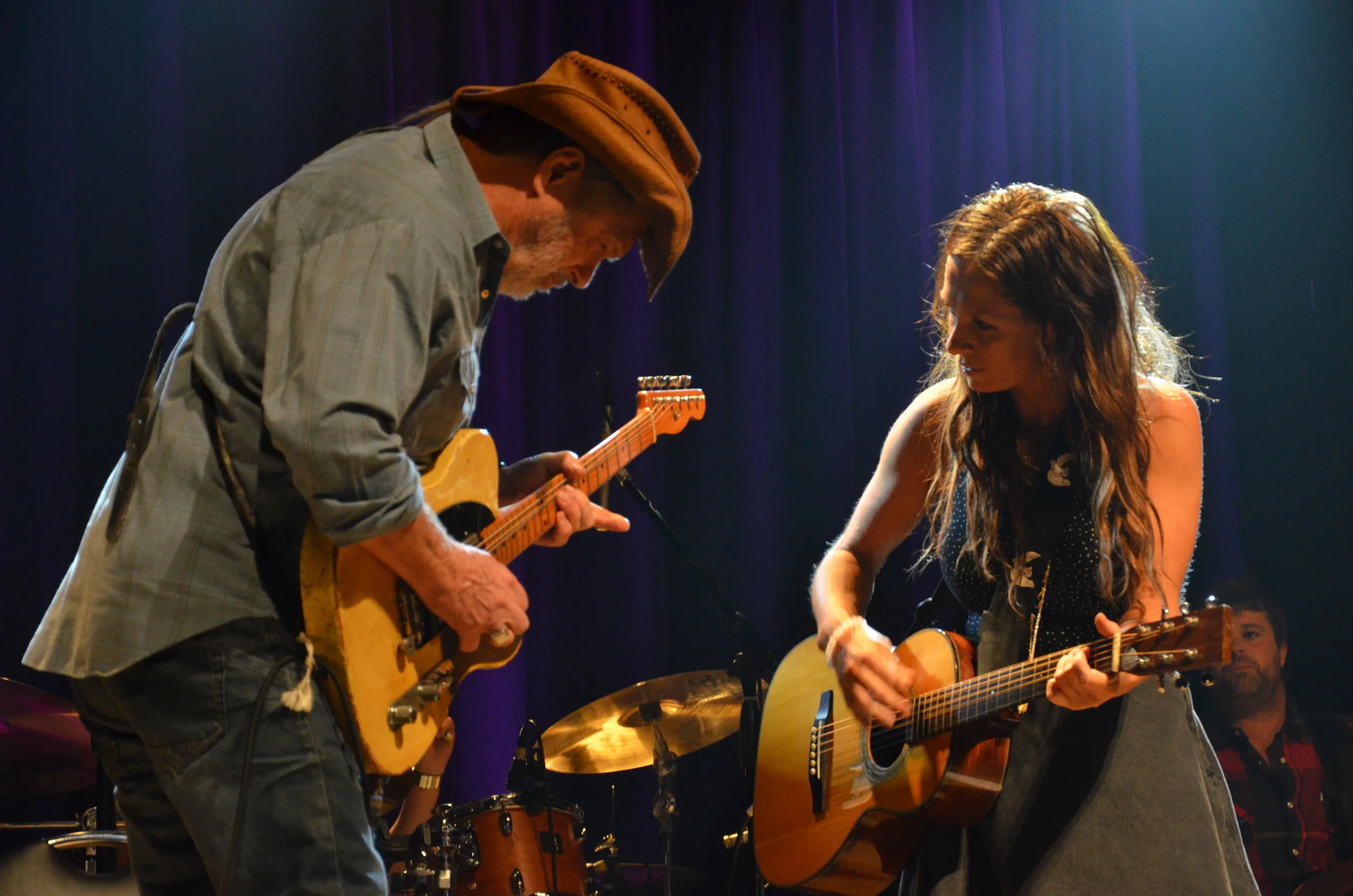
Australian country singer-songwriter Bill Chambers playing with his daughter, Kasey. Photo courtesy of Bill Chambers.
Name: Bill Chambers
Occupation: Country singer-songwriter
What’s your superpower? “I think the communication with music is a superpower—anything that tells stories from the heart.”
About this series: In this blog series, I profile people who have made a conscious decision to craft a life that allows them to meet their personal and professional aspirations. The series is intended to celebrate those who are living the life they want and to inspire others to do the same. Also, I ask everyone about their superpower, a question inspired by Ruth Ozeki’s great, great book A Tale for the Time Being.
Anyone who has ever fallen in or out of love, left home and moved as a stranger to a new place, or experienced the bewildering change that comes with new life or loss—that is, anyone who is human—can likely identify a song that captures their feelings in that moment. Music can inspire and console, champion and challenge, give us courage or give us solace.
There is a musician who can speak to every different type of heart.
Perhaps that is because becoming a musician takes a certain strength of heart—the ability to listen to what the heart really wants and go for it, money or fame be damned.
A few years ago, I was fortunate to meet Australian singer-songwriter Bill Chambers at the concert of his famous daughter, Kasey, whose stage he has been sharing as a band mate for more than a quarter of a century. At the time, he and Kasey were in the midst of a U.S. tour. Chambers talked with me about how his family went from singing together around the campfire when they lived in the Australian Outback to playing together in the country music mecca Nashville.
You grew up in a very small town in South Australia and made the decision as a dad to take your young family to live in the Nullarbor Plain. Tell me about those early years.
I grew up in a fishing village in South Australia, and my dad was a lobster fisherman. We were the only kids in the town of smelly old fishermen. In the meantime, I was listening to a lot of country music, and in my teens, I discovered Bob Dylan and the Beatles.
For a while, I was an ambitious young guitar player and used to appear on TV in Adelaide on a national show called Country Music Hour. But once I had children, my priorities changed. My wife and I decided to head to the Outback, for a totally different lifestyle. My mum and dad always lived off the land, catching local fish and growing their own vegetables, and I grew up naturally believing that if you want something done, you do it yourself, and if you want to eat something, you either hunt it or grow it.
So we picked up and moved to the Nullarbor Plain, the most remote desert, just above the Great Australian Bight. It was in the middle of the fox trade in the early ‘70s, and you could actually hunt Australian foxes, dry the skins, and sell them to Europe for quite a bit of money. My son, Nash, was 3 years old, and my daughter, Kasey, was three weeks old. My wife didn’t feel comfortable and freaked right now, but I said, “Look, we’re just here for a working holiday for four or five weeks.” I was trying to convince her this was a good idea. We didn’t stay for four weeks; we stayed for 10 years.
Eventually, my wife grew comfortable with it, and the kids grew up listening to my music around the campfire, and my wife home-schooled them. We’d sit around the campfire and sing songs, and my daughter was very influenced by the songs. So as my kids got into music, we formed a family band.
How did that experience influence your life today?
My life today is far different from where I come from or where I grew up, but it’s similar in the sense that it’s the survival of the fittest. We may be on tour in New York—about as far from the desert as you can get—but every day you deal with different problems, and you have to think quick and make decisions.
What are some of the values you have prioritized in creating your life as a musician—what are the ingredients that have made this life work for you?
I have always been ambitious and you can be ambitious in different ways—ambition is a great thing if you don’t use it against other people. I’m still ambitious. Every day, I come up with new ideas. My main thing is to create music that we’re proud of, don’t sell out, and treat people well. I like to be asked back at the venues we play at. People are good to us, and I want them to know we appreciate it. I have instilled in my daughter those values, and I think she takes it very seriously. You get out of life what you put into it. It’s not all take; you’ve got to give as well.
What has been your biggest challenge?
Finances are a problem for musicians these days. It’s very hard to make any extra money. We just survive week to week—that’s the price you pay for being on the road and living the life of a musician. But I don’t even think about it anymore. I almost always have a bed to sleep in. Even Kasey, who has done very well in the music business, hasn’t pursued the life of a superstar. She’s not tied to any particular lifestyle. She goes grocery shopping, she helps carry the instruments like the rest of us when we gig, she’s got three kids, and she wants to be a normal mother. Those things are more important than making a million dollars and being a celebrity.
What have you learned by choosing to craft your life this way?
I believe you’ve got to follow your heart. Most people these days just conform to a lifestyle, and have a normal job, working for someone. Even if people hate their job, they think, “This is what I have to do.” I don’t think you have to do that. I think you need to look for what your heart wants to do: Follow your heart and your gut feeling, believe in yourself, and don’t give up. I’m not going to give up till the day I die. I’ve made so many mistakes, but I’ve made more right ones than wrong ones.
Last question: What’s your superpower?
I think the communication with music is a superpower—anything that tells stories from the heart. So many people have come up to me and said, “You changed my life.” I have no doubt that’s a superpower.

My Commitment: 25 Percent to Advance Women and Girls
I'm reducing the cost of my services by 25 percent for projects that advance opportunities for women and girls. Here's why.

Let's give girls a better shot: Join me to advance women's empowerment.
On International Women’s Day earlier this year, I started thinking: This is the year of the woman. The year we will elect a woman president. The year my daughter saw me become the family breadwinner. The year that “women’s issues”—equal pay, protection of rights, strong leadership, powerful voices—will come into force.
This is our moment. And to do my part, I developed a plan: In January 2017, when Clinton gives her inaugural address and Obama passes the baton—first black president to first female president—I’ll start offering a discount through my own business for projects that focus on women’s empowerment. Women still get paid 75 cents to the dollar for men; I’ll take 25 percent off my hourly rate for clients who are working to improve opportunities for women and girls.
Then America elected a man who is capable of words and actions that, like Michelle Obama said, shake me to my core. I wept for my little daughter, even as I breathed a sigh of relief that she’s not yet old enough to watch the news.
But then I realized: That is selfish of me. For even if my daughter is “safe” now, millions of other little girls did hear those words, and they did watch voters validate someone whose actions are morally reprehensible.
All of our daughters and sons stand to inherit this world unless we each take action to change it. This is my action: Starting right now, and through 2017, I will reduce the cost of my communications services by 25 percent for any organization that is advancing opportunities for women and girls. And if a client pays me my full rate, I’ll donate 25 percent of that income to a group that stands up for women and girls.
I envision a world for my daughter—and her twin brother—that is inclusive and empowering. This is not the end of her story. As a writer, I intend to change it.
I want to hear from you: What are you doing to empower women and girls? Get in touch.